

In the 1800s, keeping time became more precise with advances in clocks and watches, helping industries operate smoothly. Standardized time zones emerged, simplifying travel and communication across countries, while telegraph signals improved long-distance synchronization. These innovations laid the foundation for today’s accurate timekeeping. As industries grew and technology advanced, the way people managed time evolved dramatically. If you look deeper, you’ll discover how these changes transformed daily life and global connectivity.

Get art and craft supplies delivered free with Prime
- Fast, free delivery on millions of items
- Prime Video, Amazon Music and more included
- Member-only deals all year
Key Takeaways
- The 1800s saw advancements in clock and watch technology, improving accuracy for industrial and personal use.
- Standardized time zones were introduced to coordinate schedules across regions, especially with railroads and telegraphs.
- Synchronization techniques using signals and standard settings became essential for coordinating machines and processes.
- Precise timekeeping supported innovations like interchangeable parts, assembly lines, and navigation systems.
- These developments laid the foundation for modern time management, facilitating global connectivity and economic growth.
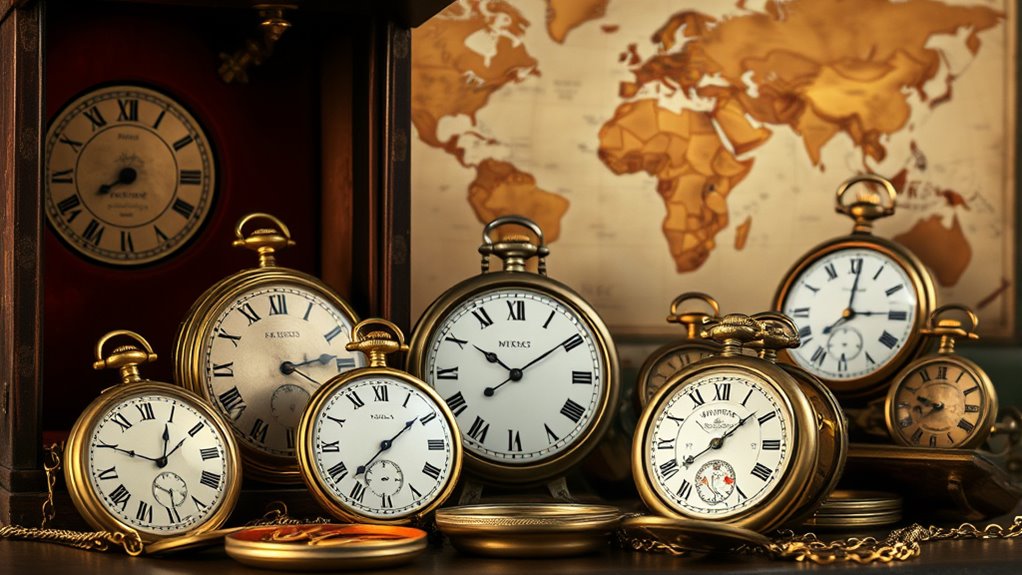
During the 1800s, the way people kept and coordinated time underwent significant changes that transformed daily life and commerce. As industries expanded and transportation networks grew, the need for precise timekeeping became more critical than ever. You might not realize it, but the development of synchronization techniques played a fundamental role in this shift. Factories began adopting new methods to ensure machines operated in harmony, reducing errors and increasing efficiency. These synchronization techniques, such as using signals and standardized time settings, allowed multiple machines and processes to work together seamlessly, which was essential for mass production. This era also saw remarkable manufacturing innovations, like the introduction of interchangeable parts and assembly lines, which depended heavily on accurate timing. By coordinating the start and stop times of various operations, manufacturers could produce goods faster and more uniformly, boosting economic growth.
You can see these changes reflected in the way time was standardized across regions. Before this period, communities kept local mean times, which varied from town to town. But as railroads and telegraph lines expanded, it became clear that a uniform system of time was necessary to coordinate schedules and avoid accidents. The advent of standardized time zones in the 1880s was a direct result of these technological advances. You might imagine how confusing it could be to rely on local times when scheduling trains or coordinating commerce, but the introduction of time zones simplified this drastically. This system divided the world into sections where the same time was maintained, making travel and communication much more efficient.
Moreover, the development of more accurate clocks and watches during this period also contributed to better synchronization. You could now rely on reliable timepieces to set your schedule, whether for personal use or industrial purposes. The improved precision of these devices meant that synchronization techniques could be implemented with greater confidence, leading to innovations in navigation, astronomy, and daily routines. Digital synchronization techniques, such as telegraph signals, became essential tools for coordinating activities across vast distances. All these advancements collectively made it possible to operate in a more interconnected and efficient world. In essence, the 1800s marked a turning point where technological and industrial progress intertwined to revolutionize how humans understood and managed time, laying the groundwork for the even more precise systems we rely on today.
As an affiliate, we earn on qualifying purchases.
Frequently Asked Questions
How Did Time Standardization Impact Daily Life in the 1800S?
Time standardization transformed your daily routines by making schedules more precise and reliable. It streamlined train travel and commerce, boosting economic activity and reducing confusion. As a result, your socioeconomic effects improved, with better coordination across regions. You experienced more punctuality and efficiency in work, travel, and social life, fostering a sense of order. This shift laid the groundwork for modern timekeeping, impacting society well beyond individual routines.
What Materials Were Commonly Used to Make 1800S Clocks and Watches?
Imagine holding a 1800s pocket watch; it’s likely made of brass or silver, with glass covering the dial. Back then, materials evolution and craftsmanship techniques shaped clockmaking—metal gears, wooden cases, and enamel dials were common. You’d notice how artisans carefully assembled these components, blending durable materials with intricate techniques, creating reliable timepieces that defined an era.
How Accurate Were 1800S Clocks Compared to Modern Ones?
You’ll find that 1800s clocks and watches had significant precision gaps compared to modern ones, mainly due to technological limitations. They were generally accurate to within a few minutes per day, whereas today’s devices can be off by mere seconds or less. These differences stem from less advanced materials and mechanical innovations, which limited the precision achievable back then. So, while impressive for their time, they couldn’t match today’s high-precision timekeeping.
Who Were the Key Inventors Behind 1800S Clock and Watch Innovations?
You should know that horological pioneers like Abraham-Louis Breguet, Charles-Édouard Jeanneret (better known as Le Corbusier), and Aaron L. Dennison led the charge in 1800s clock and watch innovations. Their invention breakthroughs, from Breguet’s perpetual calendar to Dennison’s pioneering mass production techniques, revolutionized timekeeping. These inventors pushed boundaries, making clocks more precise and reliable, transforming how you keep time today.
How Did Time Zones Spread to Less Connected Regions in the 1800S?
You see, as railroad scheduling became essential for efficiency, the need for global synchronization pushed time zones into less connected regions. Railroads used standard time to coordinate schedules, spreading the concept beyond major cities. This system gradually influenced distant areas, helping them adopt synchronized time. By embracing these innovations, you can understand how the push for better coordination in transportation and communication spread worldwide in the 1800s.
synchronized wall clock for industrial use
As an affiliate, we earn on qualifying purchases.
As an affiliate, we earn on qualifying purchases.
Conclusion
By now, you see how clocks and watches in the 1800s revolutionized daily life, bridging gaps and connecting people across vast distances. Time zones brought order to chaos, making the world a smaller, more manageable place. As technology kept ticking forward, you realize that understanding this history is like holding a key to the past. It’s clear that once you set the clock, you can’t turn back the clock—timing truly changed everything.
digital time synchronization device
As an affiliate, we earn on qualifying purchases.
As an affiliate, we earn on qualifying purchases.
As an affiliate, we earn on qualifying purchases.
Columbus Day / Indigenous Peoples' Day Picks
long weekend sales
As an affiliate, we earn on qualifying purchases.