TL;DR

Get art and craft supplies delivered free — and shop member deals
- Fast, free delivery on millions of items
- Access to Prime Big Deal Days deals on October 6–7
- Prime Video, Amazon Music and more included
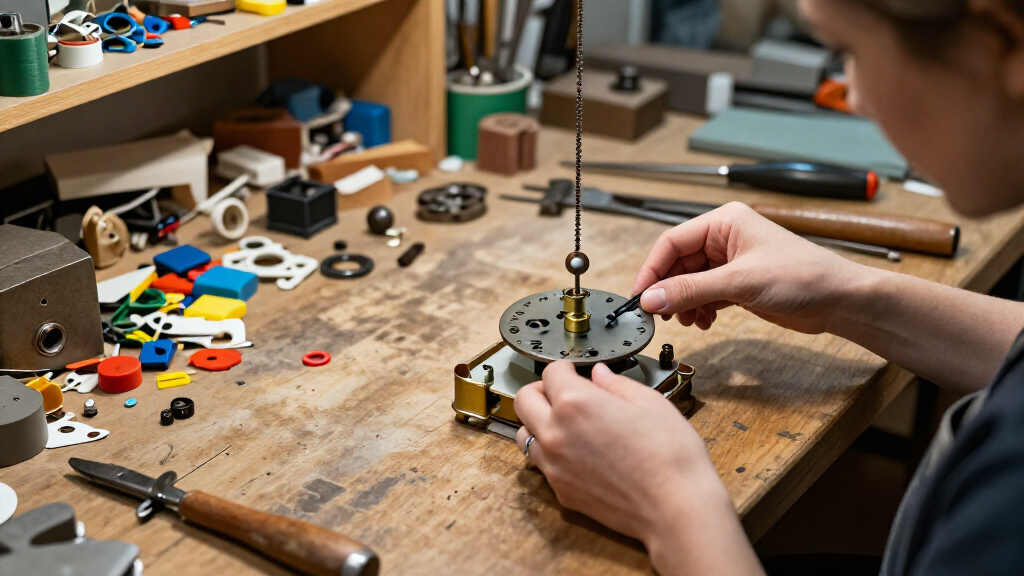
Niklas Roy’s Glashütte Trash Clock is a mechanical clockwork built from trash and other materials found in Glashütte, Saxony. Roy says it runs for about half an hour, displays seconds and minutes, strikes a gong at each minute rollover, and triggers an external randomizer shortly before its energy runs out. The project is documented on Roy’s website; its construction details beyond the supplied report are not established here.
Artist and inventor Niklas Roy says he built a functioning mechanical clock from trash and other materials he found in Glashütte, Saxony. The clock runs for about 30 minutes, displays seconds and minutes, and strikes a gong when the minute hand reaches 12, making the work a short-running mechanical timepiece rather than a conventional all-day clock.
Roy’s project report, titled Glashütte Trash Clock, describes a clockwork mechanism assembled during a 2026 stay in the German town. According to Roy, its limited run means it shows only seconds and minutes. He also says it triggers an external randomizer just before its stored energy runs out. The report does not identify the randomizer’s output or explain what it is used for.
The mechanism uses a pendulum and an escapement: a system that regulates a clock’s motion by repeatedly releasing a wheel and giving the pendulum a small push. Roy writes that he made the escapement anchor from a bent metal rod and used paper clips as teeth on the escapement wheel. With a seconds pendulum and a 30-tooth wheel, he explains, half-tooth advances at each swing let the wheel turn once per minute.
Roy says a surprise invitation from NOMOS, a mechanical watch manufacturer, brought him to Glashütte for an artist residency in 2026. He describes the clock as an effort to make a mechanism using items found in the town and tools and supplies he brought with him. The available account does not provide an independent test of the clock’s accuracy or operating duration.
A Found-Material Clock in a Watchmaking Town
The project puts a deliberately improvised object in a town associated with precision watchmaking. Glashütte is known internationally for mechanical timepieces, and the report notes that use of the designation “Glashütte/SA” is legally protected for clocks and watches made there. Roy’s work draws on that location while using found materials rather than presenting itself as a conventional commercial watch.
For readers, the technical interest is in how basic clock principles can be adapted to available materials. The clock’s short runtime and limited display are also part of its stated design: Roy describes a 30-minute mechanism, not a replacement for a standard clock. Its gong and randomizer add functions, although the report does not explain the randomizer’s purpose.
As an affiliate, we earn on qualifying purchases.
Roy’s Family and Glashütte Residency
Roy connects the project to his family history: he says his great-great-grandfather, Henri Roy, and great-grandfather, Eduard Roy, were Swiss watchmakers who later moved to Saxony and continued making clocks and watches. That history gave the 2026 residency a personal connection, according to his account, but it does not establish that the Trash Clock follows a family design or method.
Roy describes learning and experimenting with pendulums before building the clock’s regulating mechanism. His report refers to a vintage watchmaking textbook and to the familiar relationship between pendulum length and swing period. He then adapted an escapement—a mechanism used in pendulum clocks—to materials he had available. This is the background needed to understand how the project turns a swinging pendulum into counted movement; it is not a report of a newly invented clock principle.
As an affiliate, we earn on qualifying purchases.
Accuracy, Testing and Randomizer Details
The project account describes the clock as functioning and gives its run time as about half an hour, but it does not report measured timing accuracy, repeated test results, or how long the mechanism was observed under controlled conditions. It is also unclear whether the clock is currently operating, on display, or available for visitors to see.
The report does not give a complete inventory of the materials, a detailed construction guide, or a precise explanation of how energy is stored and delivered through the full mechanism. It also leaves the external randomizer’s design and purpose unspecified. Those details should not be inferred from the brief description of the clock’s operation.
As an affiliate, we earn on qualifying purchases.
Further Documentation Would Clarify Operation
Roy’s website is the source for the project description provided here, but no subsequent exhibition, public demonstration, or additional testing is confirmed in that account. No next event or release date is specified. Further details from Roy—particularly a full mechanism description, accuracy tests, and an explanation of the randomizer—would clarify how the clock performs and how its features work.
As an affiliate, we earn on qualifying purchases.
Key Questions
What is the Glashütte Trash Clock?
It is a mechanical clockwork project by Niklas Roy, made from trash and other materials he says he found in Glashütte, Saxony.
How long does the clock run?
Roy says it runs for about half an hour. The report does not provide independent test results or a more exact runtime.
What does the clock display and do?
Roy says it displays seconds and minutes, strikes a gong when the minute hand reaches 12, and triggers an external randomizer shortly before its energy runs out.
What materials make up its escapement?
According to Roy, the anchor is made from a carefully bent metal rod, while paper clips form the escapement wheel’s teeth.
Is the clock available to see or buy?
The supplied project report does not confirm a public display, sale, or current location. Its present availability is unclear.
Source: hn
Fall Picks
fall essentials
As an affiliate, we earn on qualifying purchases.