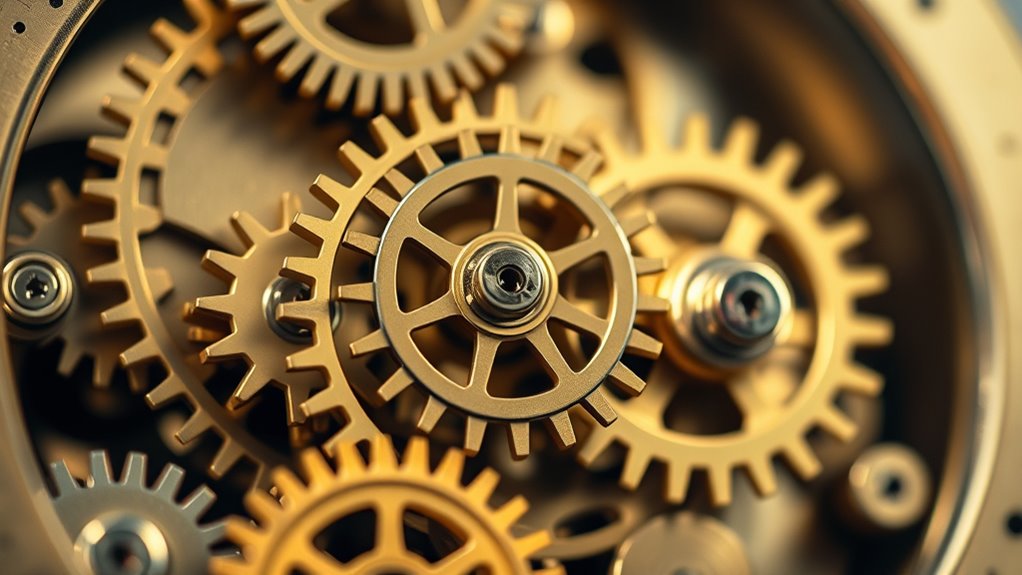

Gears and clockwork mechanisms work together to transfer motion and regulate energy in precise devices like watches and machines. Gears mesh through teeth to control speed and torque, while escapement systems release energy in small, controlled amounts to maintain everything running accurately. By adjusting gear ratios and designing components carefully, these systems ensure reliability and precision. If you keep exploring, you’ll discover how these intricate parts create the perfect harmony behind everyday machinery.

Get art and craft supplies delivered free with Prime
- Fast, free delivery on millions of items
- Prime Video, Amazon Music and more included
- Member-only deals all year
Key Takeaways
- Gears transfer motion and power within clockwork systems through interlocking teeth, ensuring precise operation.
- Gear ratios control the speed and torque of movement, vital for accurate timekeeping.
- Escapement systems regulate energy release, converting continuous power into controlled, incremental movements.
- Gear design—including size, shape, and teeth count—determines the speed and efficiency of mechanical mechanisms.
- Gears and escapements work together seamlessly, forming the core of reliable, accurate clockwork and machinery.
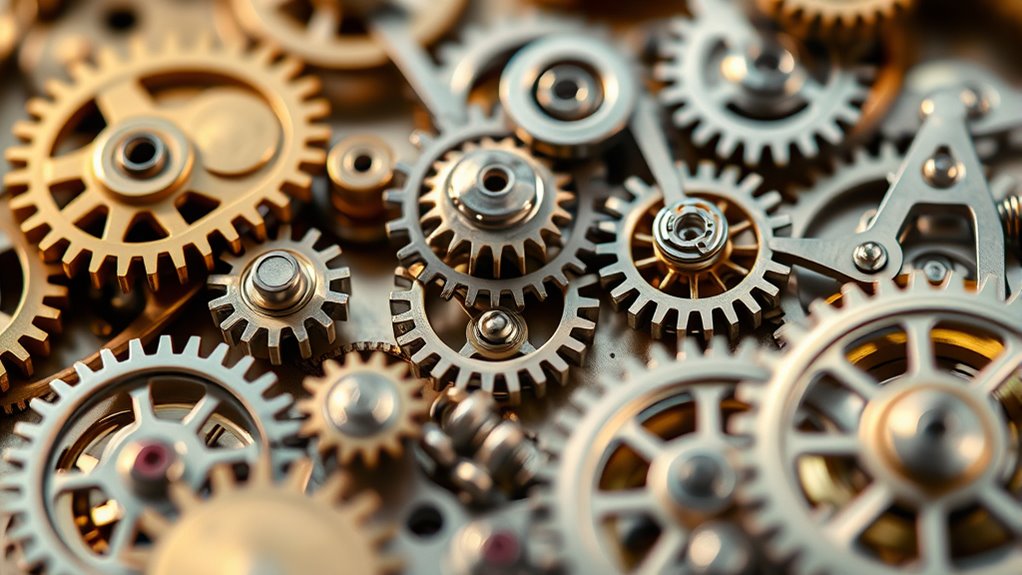
Gears and clockwork mechanisms form the intricate foundation of many precise machines, from watches to industrial equipment. They are essential for transferring motion and control, ensuring that each component works harmoniously. When you look closely at a watch or a complex machine, you’ll notice how gears interlock, transferring energy through their teeth. Understanding gear ratios is critical because they determine how fast or slow a gear turns relative to another. For example, in a watch, adjusting the gear ratios allows the movement to keep accurate time by controlling the speed at which the hands move. A small gear turning a larger gear reduces the speed but increases torque, which is indispensable for precision and power management within the mechanism.
Gears and gear ratios are essential for precise control and power transfer in mechanical systems.
In clockwork devices, escapement systems play an imperative role. They act as the heartbeat of the mechanism, regulating the release of energy from the power source, such as a wound spring. The escapement allows the gear train to advance in precise steps, converting continuous energy into controlled, incremental movements. This regulation maintains the accuracy of the timepiece by ensuring that the gears turn at a consistent rate. Without an escapement system, the gears would either spin uncontrollably or lose synchronization, making timekeeping unreliable. Different escapements, like the lever escapement, are designed to optimize accuracy and energy efficiency, working in tandem with gear ratios to produce reliable movement.
You can think of gears as the gears in a well-oiled machine, each one playing a specific role. Their teeth mesh smoothly, transmitting rotational motion without slipping. The design of each gear—its size, shape, and teeth count—determines its gear ratio. When you change these parameters, you alter the speed and torque delivered to different parts of the mechanism. This precise control is especially important in applications like watches, where even a tiny miscalculation can affect accuracy. The escapement system complements this by controlling the release of energy, ensuring that the gear train operates smoothly and consistently over time.
In essence, gears and clockwork mechanisms work together seamlessly. Your understanding of gear ratios and escapement systems reveals how careful engineering ensures precision and reliability. Whether in a delicate wristwatch or industrial machinery, these components form the backbone of accurate, efficient, and durable mechanical systems. Their interplay allows machines to function with the exactness that modern technology demands, highlighting the ingenuity behind centuries of clockmaking and mechanical design.
Frequently Asked Questions
How Do Gears Impact the Accuracy of Clocks?
Gears substantially impact clock accuracy through their gear tooth design and lubrication. Precise gear tooth design ensures smooth, consistent movement, reducing errors caused by slipping or uneven engagement. Proper gear lubrication minimizes friction and wear, maintaining accurate gear rotation over time. When both are optimized, the clock’s mechanism runs reliably, keeping accurate time. So, paying attention to gear tooth design and lubrication directly enhances a clock’s precision and longevity.
What Materials Are Best for High-Precision Gear Manufacturing?
You should choose gear materials like stainless steel, brass, or high-grade alloys for high-precision manufacturing, as they offer excellent durability and stability. Prioritize materials that allow tight manufacturing tolerances, minimizing gear backlash and ensuring accurate movement. Proper gear material selection directly impacts precision, so focus on materials that resist wear and maintain shape under stresses, ultimately improving clock accuracy and longevity.
How Do Gear Ratios Influence Clock Speed?
You see, gear ratios directly influence clock speed by controlling how quickly torque transmits through the gear train. A higher gear ratio increases the speed of the output, making the clock run faster, while a lower ratio slows it down. By adjusting these ratios, you optimize torque transmission and control the clock’s timing precisely, ensuring accurate and reliable operation within the gear train system.
What Are Common Issues in Gear Maintenance?
Think of gear maintenance as tending a delicate garden—you need to address lubrication challenges and guarantee proper gear alignment. Common issues include wear and tear from insufficient lubrication, which causes gears to grind and slip, and misalignment that leads to uneven wear and potential failure. Regularly checking and applying the right lubricant, along with precise alignment, keeps your gears running smoothly and prevents costly breakdowns.
How Do Modern Electronics Integrate With Traditional Gear Mechanisms?
You integrate modern electronics with traditional gear mechanisms by using digital synchronization and electronic feedback systems. These technologies allow precise control of gear movements, improving accuracy and efficiency. Sensors relay real-time data to electronic controllers, which adjust gear operation accordingly. This seamless integration enhances automation, reduces wear, and enables complex timing tasks, making traditional gear systems smarter and more adaptable for contemporary applications.
Conclusion
As you grasp the intricate dance of gears and clockwork, you see how they symbolize life’s constant motion and interconnectedness. Each cog turning represents your own moments of change, while the steady tick echoes your pursuit of purpose. Remember, just like a finely tuned mechanism, your life relies on harmony and precision. Embrace the rhythm, and you’ll find that every small gear contributes to the grand, beautiful clockwork of your journey.
Halloween Picks
halloween
As an affiliate, we earn on qualifying purchases.