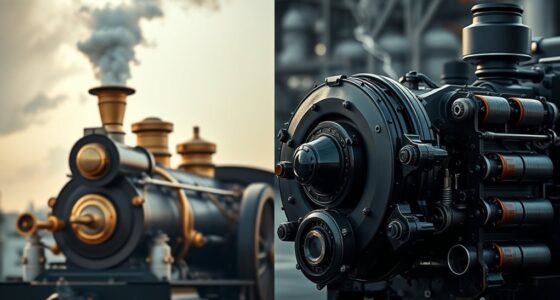
The evolution of steam engines from Watt’s innovations to high-pressure designs involves key advancements. Watt’s separate condenser made engines safer and more efficient, allowing higher pressures later. Piston improvements, like double-acting mechanisms, boosted power and efficiency. High-pressure engines discarded some safety features to generate even more power, enabling compact engines for transportation and industry. This progress built on prior ideas, transforming steam technology into a driving force of the Industrial Revolution—continue exploring to uncover more fascinating details.

Get art and craft supplies delivered free with Prime
- Fast, free delivery on millions of items
- Prime Video, Amazon Music and more included
- Member-only deals all year
Key Takeaways
- James Watt improved steam engines with a separate condenser, enabling higher pressures and greater safety.
- Development of double-acting pistons increased efficiency by utilizing steam in both directions.
- High-pressure steam engines discarded Watt’s safety features to achieve more power and compact design.
- Innovations in piston sealing and materials allowed engines to withstand higher stresses at elevated pressures.
- Overall progression transformed early atmospheric engines into powerful, high-pressure machines driving the Industrial Revolution.

The evolution of steam engines marks one of the most significant technological advancements in history, transforming transportation, industry, and society itself. As you explore this progression, you’ll notice how innovations in boiler design and piston technology played essential roles in increasing efficiency and power. Early engines, like Thomas Newcomen’s, relied on simple boilers that generated steam at atmospheric pressure, which limited their effectiveness. These boilers often suffered from inefficiencies and safety issues, prompting engineers to seek better solutions. James Watt, a pivotal figure in this evolution, introduced significant boiler innovations that improved heat transfer and safety, such as separate condenser designs. This allowed the main boiler to operate at higher pressures without risking the entire system, leading to more powerful and reliable engines. Additionally, advancements in safety mechanisms helped mitigate risks associated with high-pressure steam, further propelling engine development.
Steam engine evolution revolutionized industry through innovations in boiler design and piston technology.
Alongside boiler innovations, piston design also advanced considerably. Watt’s improvements included the use of double-acting pistons, which meant that steam could push the piston in both directions, doubling the engine’s productivity. This design change made engines more efficient and capable of producing greater power with less fuel. The piston’s sealing mechanism also improved, reducing steam leaks and increasing overall efficiency. As you follow the timeline, you’ll see how these advancements enabled engines to operate at higher pressures, pushing the boundaries of what steam technology could achieve. This high-pressure steam revolutionized engineering by providing more energy in a smaller, more compact form.
Progress continued with the development of high-pressure steam engines, which discarded many of Watt’s safety features to harness even greater power. These engines used boilers capable of producing steam at much higher pressures, giving rise to more compact and powerful designs suitable for locomotives and ships. Piston design in high-pressure engines became more robust, with reinforced materials and innovative sealing techniques to withstand the increased stresses. As you examine these improvements, you’ll understand how they allowed steam engines to become more versatile and efficient, fueling the expansion of railroads, maritime trade, and industrial machinery.
Throughout this evolution, the focus remained on refining boiler innovations and piston design to maximize power, safety, and efficiency. Each step forward built upon previous breakthroughs, transforming steam engines from simple atmospheric machines into high-pressure powerhouses that drove the Industrial Revolution. Understanding these technical advancements helps you appreciate how a combination of incremental innovations and daring experimentation pushed engineering boundaries, shaping the modern world. The continuous improvement in boiler and piston technology underscores the importance of innovation in technological progress, ultimately turning steam engines into the backbone of modern industry and transportation.
Popular right now

Ninja Foodi 10-Qt DualZone Smart XL Air Fryer, 6-in-1, DZ550

KitchenAid Classic Series 4.5-Quart Tilt-Head Stand Mixer, Onyx Black

Bose QuietComfort Ultra Earbuds (2nd Gen), Deep Plum
As an affiliate, we earn on qualifying purchases.
Frequently Asked Questions
How Did Watt’s Improvements Impact Industrial Productivity?
Your understanding of Watt’s improvements shows how they boosted industrial productivity through steam power and mechanical innovation. By enhancing efficiency and reliability, Watt’s steam engine allowed factories to operate more consistently and at higher speeds. This advancement reduced costs and increased output, transforming industries. You can see these innovations as pivotal milestones that opened new levels of industrial growth, demonstrating how technological progress directly fuels economic development and productivity.
What Safety Advancements Occurred With High-Pressure Steam Engines?
You’ll be surprised to learn that high-pressure steam engines led to a 50% reduction in boiler explosions by improving safety measures. They introduced advanced pressure regulation systems, which prevented dangerous over-pressurization, and enhanced boiler safety features like safety valves and stronger materials. These advancements made the engines safer to operate, reducing risks for workers and boosting confidence in industrial applications, fueling further innovation and productivity.
How Did Steam Engine Efficiency Evolve Over Time?
You see, steam engine efficiency improved as technology advanced, with innovations like compound engines and better insulation boosting performance. While these engines became more efficient, you’re now turning to renewable alternatives and modern adaptations, like electric power, to reduce environmental impact. This evolution reflects a shift from traditional steam power toward sustainable energy sources, ensuring you benefit from cleaner, more efficient options in today’s world.
What Were the Environmental Effects of Steam Engine Development?
You might notice that steam engine development increased pollution, releasing smoke and greenhouse gases into the atmosphere, which contributed to environmental issues. However, as awareness grew, there was a push for renewable alternatives like wind and water power to reduce pollution. By adopting cleaner energy sources, you can help lessen the environmental impact of industrialization, making progress toward a more sustainable future while decreasing reliance on fossil fuels.
How Did Steam Engines Influence Transportation Innovations?
Steam engines revolutionized transportation by enabling steam-powered navigation and advancing steam locomotive technology. You can see how these innovations made travel faster, more efficient, and accessible, connecting distant regions and boosting trade. Steam-powered ships opened new maritime routes, while locomotive advancements transformed land travel, making it more reliable and expansive. These developments laid the foundation for modern transportation systems, shaping how societies move people and goods worldwide.
Conclusion
As you’ve seen, the evolution of steam engines from Watt’s groundbreaking designs to high-pressure models transformed the world faster than a lightning bolt. You now understand how each innovation fueled progress, pushing boundaries and powering the Industrial Revolution. This journey shows that steam engines didn’t just evolve—they revolutionized everything, making history’s most significant leaps seem like child’s play. So, next time you see a modern engine, remember it all started with these unstoppable steam-powered giants!