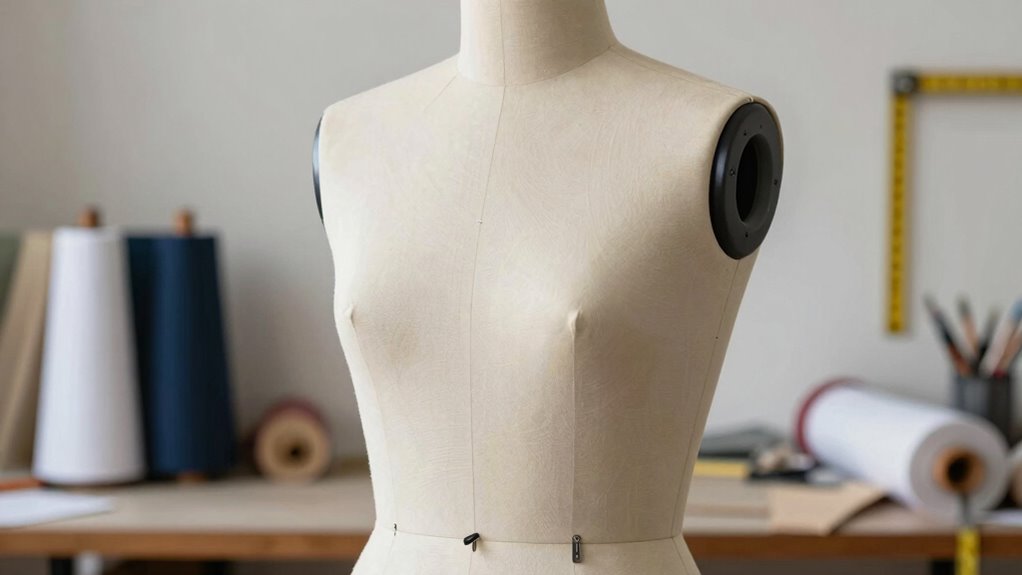

To use a tailor’s dummy for better fit and proportion, start by selecting fabrics similar to your final material. Cover the dummy with muslin or inexpensive fabric, then pin and adjust pattern pieces directly on the form for real-time tweaks. Regularly step back to assess the silhouette from all angles, making small adjustments for balance and fit. Practice helps you develop an intuitive sense of proportion and improves craftsmanship—keep exploring to master these techniques fully.

Get art and craft supplies delivered free with Prime
- Fast, free delivery on millions of items
- Prime Video, Amazon Music and more included
- Member-only deals all year
Key Takeaways
- Select fabrics that match the final garment’s weight, stretch, and drape for realistic fitting.
- Cover the dummy with muslin or inexpensive fabric for pattern adjustments and pinning.
- Wrap and pin fabric around the dummy to visualize fit and make real-time pattern tweaks.
- Check fit from all angles, adjusting patterns to improve balance, proportion, and overall silhouette.
- Practice patience and attention to detail to enhance your tailoring skills and achieve professional results.

Have you ever wondered how professional tailors achieve perfectly fitted garments? The secret often lies in the precise use of a tailor’s dummy, which allows you to see how fabric and patterns come together on a three-dimensional form. To get the most out of your dummy, you need to start with careful fabric selection. Choose fabrics that mirror the weight, stretch, and drape of the final material you plan to use. For instance, if you’re working on a lightweight silk blouse, don’t practice on heavy denim or thick wool. The fabric’s behavior influences how it fits and falls on your dummy, giving you a realistic preview of the finished piece. When you select the right fabric, it becomes easier to identify how it will respond to cutting, sewing, and pressing, leading to a more accurate final fit.
Once you’ve picked suitable fabric, the next essential step is pattern adjustment. Your dummy acts as a real-time platform for tweaking patterns before cutting into expensive material. Cover your dummy with muslin or inexpensive fabric first; this allows you to pin and adjust your pattern pieces directly on the form. As you pin, pay attention to areas like the bust, waist, and hips, making sure the pattern conforms smoothly without puckers or bunching. If the pattern is slightly off, don’t hesitate to make incremental adjustments—take in darts, widen seams, or reshape armholes. These tweaks ensure that the pattern aligns perfectly with your body’s proportions, which can be difficult to gauge on flat paper alone. The dummy acts as your mirror, revealing how your pattern interacts with the fabric’s natural drape and your body’s contours. Additionally, understanding how the fabric behaves on a form can help you better anticipate fabric response, which is crucial for quality tailoring. Recognizing the importance of body measurements can also significantly improve the fit and proportion of your final garment. Developing an understanding of garment fitting techniques will further enhance your ability to achieve professional results. Furthermore, practicing pattern adjustments on a dummy can help you develop a more intuitive sense of proportion and balance, essential for creating well-fitting garments.
Using the dummy correctly also involves checking the garment’s fit from all angles. Wrap the fabric around the dummy, pinning or tacking as you go, and step back periodically to assess the silhouette. Small adjustments to the pattern, based on what you see on the dummy, can make a big difference in achieving a polished look. As you practice, you’ll notice that pattern adjustment becomes more intuitive, and your ability to select the right fabric improves your overall craftsmanship. With patience and attention to detail, your dummy becomes an invaluable tool, helping you create garments that fit perfectly, look professional, and feel comfortable. By mastering fabric selection and pattern adjustment on your tailor’s dummy, you turn a basic form into a powerful workshop for flawless tailoring.
As an affiliate, we earn on qualifying purchases.
Frequently Asked Questions
Can I Adjust the Dummy’s Height Easily?
Yes, you can easily adjust the dummy’s height for better fit and proportion. Most adjustable dummies feature a simple mechanism, like a screw or clamp, allowing you to modify the height quickly. This dummy customization makes it easier to tailor your garments to different sizes. Just loosen the adjustment, set it to your desired height, and tighten securely. It’s a practical tool for achieving precise fitting and consistent tailoring results.
What Materials Are Best for Covering a Tailor’s Dummy?
Think of covering your dummy like dressing a statue; you want it to look seamless and professional. Opt for fabric options like muslin, canvas, or cotton twill, which are sturdy and easy to work with. Covering materials such as foam or batting can add padding and smoothness, ensuring your dummy maintains its shape. These choices help you create a clean, adaptable surface perfect for fitting and designing with precision.
How Often Should I Update the Dummy’s Measurements?
You should update your dummy’s measurements whenever your body changes considerably or after completing a new fitting. Regular updates improve measuring accuracy and guarantee your garments fit perfectly. Schedule dummy maintenance every few months to check for any wear or inaccuracies. Keeping measurements current helps you avoid fitting issues and maintains the dummy’s usefulness as a precise tool for tailoring. Consistent updates make your sewing projects more successful and professional-looking.
Is a Dress Form Suitable for All Clothing Styles?
A dress form is like a chameleon, but it might not suit every clothing style perfectly. While it offers great fashion versatility and helps with style adaptability, some intricate or highly structured designs may need adjustments beyond the dummy’s capabilities. For casual wear or simple designs, it’s ideal. However, for avant-garde or heavily detailed garments, you might need additional tools or custom forms to capture the full essence of your style.
Can I Use a Dummy for Fitting Children’s Clothing?
Yes, you can use a dummy for fitting children’s clothing. Just guarantee the dummy’s size matches the child’s measurements closely. You may need to make dummy adjustments, like adding padding or altering dimensions, to better fit different ages or sizes. This helps you accurately check the fit, proportion, and comfort of children’s clothing, making your sewing process more precise and ensuring the final product suits young wearers perfectly.
As an affiliate, we earn on qualifying purchases.
Conclusion
Using a tailor’s dummy isn’t just about fitting your clothes; it’s about transforming your wardrobe into a masterpiece of perfection. When you master this tool, you reveal the secrets to flawless proportion and breathtaking fit—all without stepping into a boutique or wasting endless hours. It’s like having a personal fashion wizard at your fingertips, turning every stitch into a work of art. Embrace it, and watch your sewing skills soar to legendary heights!
As an affiliate, we earn on qualifying purchases.
As an affiliate, we earn on qualifying purchases.
Halloween Picks
halloween
As an affiliate, we earn on qualifying purchases.