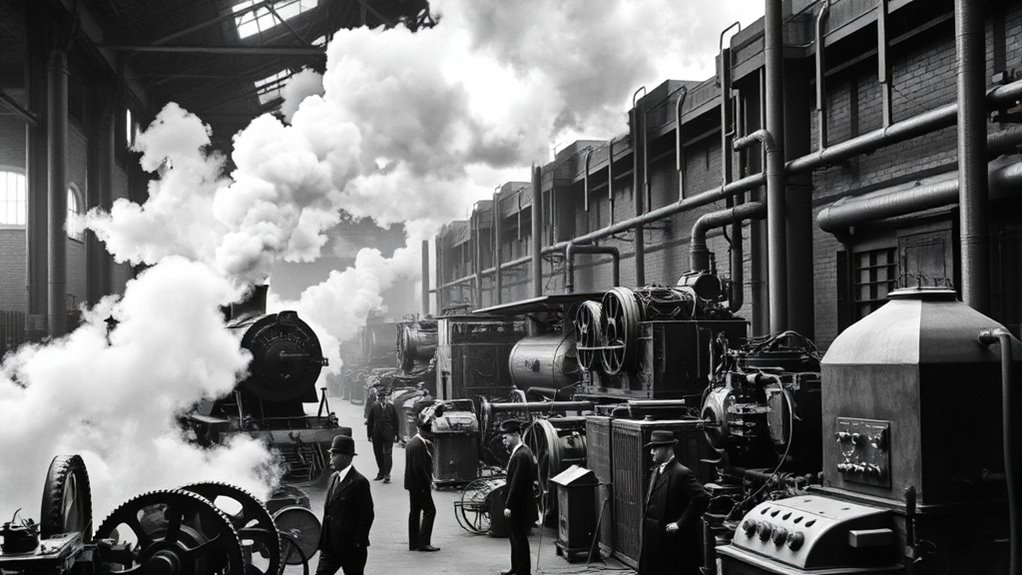

In the 19th century, steam power revolutionized industry and transportation by harnessing coal to drive engines, enabling rapid manufacturing growth and expanded trade. Meanwhile, electricity gradually offered a cleaner, more adaptable energy source, supporting innovations like lighting, communication, and small machinery. Though steam remained dominant for decades, electricity’s flexibility made it increasingly useful, eventually transforming daily life and industry. To understand how these technologies shaped the era’s progress, keep exploring their unique impacts and legacy.
Key Takeaways
- Steam power revolutionized transportation and manufacturing, enabling rapid industrial growth in the 19th century.
- Electricity offered cleaner, more flexible energy, supporting innovations like lighting, communication, and automation.
- Steam engines provided reliable, centralized power but required water sources and large infrastructure.
- Electrical power gradually replaced steam in urban settings and industries due to efficiency and versatility.
- The transition from steam to electricity was gradual, with steam remaining dominant throughout much of the 19th century.
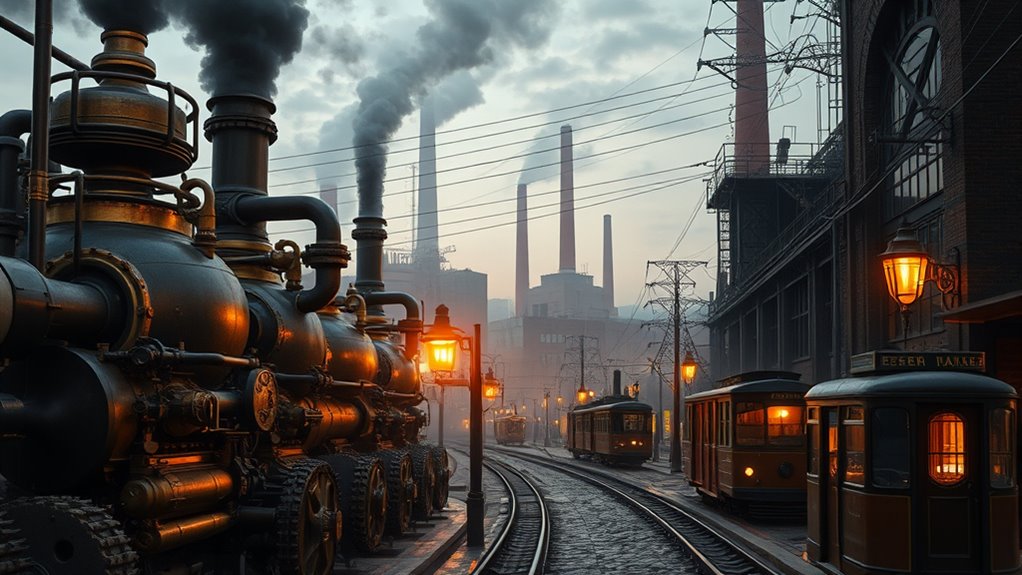
Have you ever wondered which power source revolutionized industry more: steam or electricity? In the 19th century, both played crucial roles, but their impacts differed significantly. The steam engine, the hallmark of early industrial progress, transformed transportation and manufacturing. It powered trains, ships, and factory machinery, making previously impossible feats of mobility and production routine. The steam engine harnessed the energy stored in coal and converted it into mechanical work, allowing industries to grow rapidly. Its development marked a shift from manual labor and water-powered machinery to a system where centralized factories could operate independently of natural water sources. This innovation fueled economic expansion, urbanization, and global trade, establishing steam as the backbone of 19th-century industry.
Meanwhile, electrical innovation began gaining momentum toward the end of the century, setting the stage for a new era. Electricity offered a different kind of power—cleaner, more flexible, and capable of being transmitted over long distances. As electrical technology advanced, it soon became evident that it could replace many steam-powered applications. Electric motors, for example, proved more efficient and easier to operate than traditional steam engines, especially in small-scale and indoor environments. It wasn’t just about replacing steam engines but also about creating new possibilities—lighting, communication, and automation. The introduction of electrical innovation meant factories could be illuminated for longer hours, cities could develop more sophisticated communication networks with the telegraph and telephone, and new appliances and devices started emerging, changing daily life. The transition to electric power also led to the development of power distribution systems, which made electrical energy more accessible and reliable.
Despite the promise of electricity, the steam engine remained dominant for decades. Its proven reliability and the vast infrastructure built around it meant that it was deeply embedded in industry and transportation. Electric power, while revolutionary, initially found its niche in specific applications. However, as electrical innovations advanced, they began to complement and eventually challenge steam power. The shift wasn’t immediate but gradual, with electricity gradually replacing steam in certain industries and urban settings. This transition laid the groundwork for the modern power systems we rely on today. Still, the steam engine’s role in propelling the 19th century forward remains monumental. It was the catalyst that *freed* the age of industrialization, setting the stage for innovations—like electrical power—that would shape the 20th century and beyond.

ARCTIC MX-6 (4 g, incl. 6 MX Cleaner) - Ultimate Performance Thermal Paste for CPU, Consoles, Graphics Cards, laptops, Very high Thermal Conductivity, Long Durability, Non-Conductive
20% BETTER PERFORMANCE: With its improved composition, the ARCTIC MX-6 has a measurably lower thermal resistance than the...
As an affiliate, we earn on qualifying purchases.
Frequently Asked Questions
How Did Steam and Electricity Influence Global Economic Development?
You see how steam and electricity drove industrial innovation, transforming economies worldwide. They increased production speeds and efficiency, creating new industries and jobs. This labor transformation shifted work from manual to mechanized, boosting economic growth. You benefit from these advancements today—faster goods, cheaper prices, and new opportunities. Their influence helped shape a connected, modern economy, laying the foundation for today’s global trade and technological progress.
What Were the Environmental Impacts of Steam Engines Versus Electrical Systems?
You’ll find that steam engines increased pollution levels and caused resource depletion due to coal burning and water use. Electrical systems, on the other hand, generally produce fewer emissions, especially as cleaner energy sources develop. While electricity still impacts the environment, it tends to be less harmful, reducing pollution levels and conserving resources over time. Overall, electricity offers a cleaner alternative, but both have environmental challenges to address.
How Did Public Perception of Steam and Electricity Differ During the 19TH Century?
You might think society quickly embraced electricity, but public trust was cautious at first, fearing its safety and reliability. In contrast, steam engines gained societal acceptance faster, seen as powerful and essential for progress. People viewed steam as a symbol of industrial strength, while electricity’s potential for danger kept some skepticism. Over time, as safety improved, public perception shifted, making electricity more trusted and accepted in everyday life.
Which Technology Faced More Technological Challenges in Widespread Adoption?
You find that electricity faced more technological hurdles and adoption barriers than steam. While steam technology was well-developed and widely accepted, electricity required breakthroughs in safety, storage, and transmission. These challenges slowed its widespread adoption, as engineers worked to overcome issues like efficient generation and distribution. In contrast, steam engines already proved reliable, making their adoption smoother despite some technological hurdles.
How Did Steam and Electricity Shape Urban Infrastructure in the 19TH Century?
You see, steam and electricity revolutionized urban infrastructure by transforming urban planning and transportation networks. Steam power enabled the development of railways, steamships, and extensive factory systems, making cities more connected and industrialized. Electricity introduced efficient lighting, modern streetcars, and communication systems like the telegraph. These innovations shaped the growth of cities, improved mobility, and laid the foundation for modern urban living, fundamentally changing how cities expanded and functioned.

Thermal Grizzly Kryonaut Extreme - 2 Gram - Extremly High Performance Thermal Paste - for Maximum Thermal Conductivity While Overclocking CPU/GPU/PS4/PS5/Xbox
EXTREME HEAT CONDUCTIVITY - With a extreme high thermal conductivity, Kryonaut oers exceptional heat transfer, making it perfect...
As an affiliate, we earn on qualifying purchases.
Conclusion
As you’ve seen, steam and electricity each had their moment in the spotlight, shaping the 19th century in their own way. While steam powered the engines and factories, electricity sparked a new era of innovation and possibility. It’s clear that choosing between them was like comparing apples and oranges—both essential, yet different. Ultimately, the true winner was progress itself, pushing boundaries and lighting the way for future generations to come.

Thermal Grizzly Kryonaut - 1 Gram - Extremely High Performance Thermal Paste + 12 Cleaning Wipes 6 Wet & 6 Dry - for Demanding Applications and Overclocking CPU/GPU/PS4/PS5/Xbox
EXTREME HEAT CONDUCTIVITY - With an exceptional thermal conductivity, Kryonaut is perfect for even the most demanding congurations...
As an affiliate, we earn on qualifying purchases.

ARCTIC MX-6 (4 g) - Ultimate Performance Thermal Paste for CPU, Consoles, Graphics Cards, laptops, Very high Thermal Conductivity, Long Durability, Non-Conductive
20% BETTER PERFORMANCE: With its improved composition, the ARCTIC MX-6 has a measurably lower thermal resistance than the...
As an affiliate, we earn on qualifying purchases.