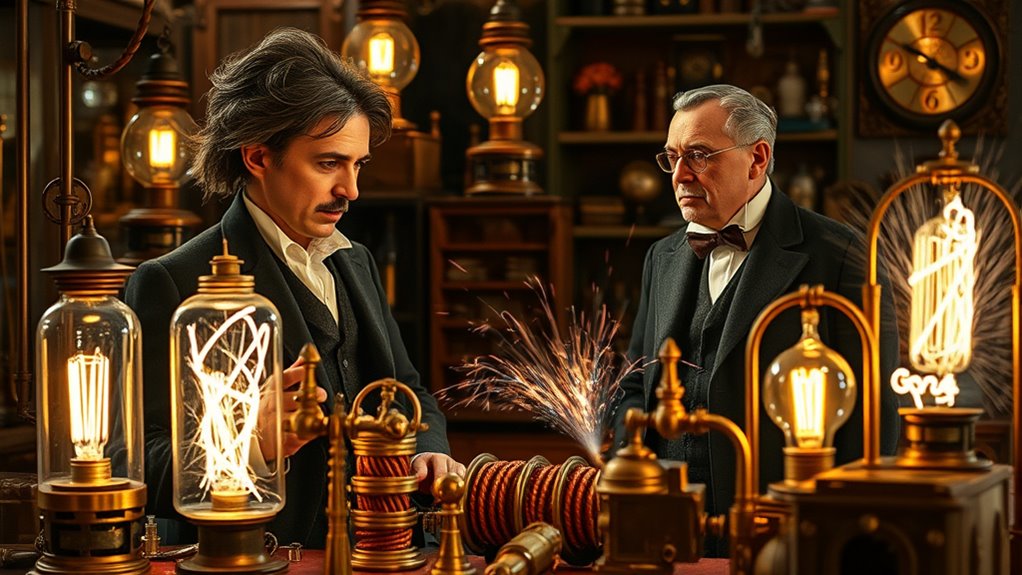

Victorian pioneers like Tesla and Edison transformed electrical technology, shaping the modern world you rely on today. Edison developed practical electrical systems that lit up cities, making urban life safer and more productive. Tesla experimented with wireless power, hinting at a future where energy could travel freely through space. Their innovations sparked a revolution that led to today’s interconnected electrical infrastructure. If you keep exploring, you’ll uncover how their groundbreaking ideas continue to influence your everyday life.
Key Takeaways
- Victorian pioneers like Edison and Tesla advanced electrical technologies, transforming society through innovations in lighting, power distribution, and wireless transmission.
- Edison focused on practical electric lighting systems, while Tesla pioneered wireless power experiments, pushing boundaries of electrical science.
- Arc lighting revolutionized urban illumination, making cities safer and enabling extended industrial productivity during the Victorian era.
- Tesla’s experiments demonstrated wireless electricity transmission, inspiring visions of a connected, energy-efficient future.
- These early innovations laid the foundation for modern electrical infrastructure, communication systems, and global energy networks.

Have you ever wondered how electricity transformed Victorian society? It was a time of rapid innovation, where inventors like Tesla and Edison pushed the boundaries of what was possible. Among their many breakthroughs, wireless power and arc lighting stand out as pivotal advancements that changed the way people lived and worked. Imagine a world where wires no longer limited your environment, where light could be sent through the air, and where cities gleamed brighter than ever before. That’s what Victorian electricity brought to life, sparking a revolution that laid the groundwork for modern technology.
Victorian electricity revolutionized society with wireless power and arc lighting, transforming cities and inspiring modern innovation.
Wireless power, in particular, captured the imagination of many during this era. Tesla’s experiments aimed to transmit electricity without wires, hoping to provide free energy worldwide. Though his grand vision wasn’t fully realized at the time, his work demonstrated that electricity could be transmitted through the air, promising a future where power lines might become obsolete. This idea of wireless power fascinated the Victorian public, fueling hopes of a more connected and efficient society. Despite the challenges, Tesla’s pioneering efforts showed that electricity wasn’t confined to wires; it could be a force that traveled freely through space, opening up new possibilities for technology and communication.
Alongside wireless power, arc lighting revolutionized urban areas by providing powerful, reliable illumination. Before electric lights, cities relied on gas lamps, which were dim, hazardous, and limited in scope. Arc lighting changed that by using an electric arc—an intense, bright spark—to produce light. This technology made it possible to light large areas, like streets and factories, with a brightness that gas lamps simply couldn’t match. You could stroll through well-lit streets at night, feel safer, and see clearly during evening hours. Arc lighting also boosted industrial productivity, extending working hours and improving safety in factories. The development of this technology was driven by the desire for urban illumination and efficiency, transforming the night into a new domain of activity and safety.
These innovations, driven by the inventive minds of Tesla and Edison, exemplify the Victorian obsession with progress and the desire to harness electricity’s potential. Edison’s development of practical electrical systems and Tesla’s futuristic ideas about wireless power pushed society forward, turning what once seemed like science fiction into reality. Their work didn’t just light up cities; it sparked a broader movement that would eventually lead to the interconnected world we live in today. As you reflect on Victorian electricity, remember that these early experiments and inventions set the stage for the modern electrical age, shaping the way you experience light, energy, and connectivity every day.
Frequently Asked Questions
How Did Victorian Inventors Secure Funding for Electrical Experiments?
You typically secured funding for electrical experiments by using patent strategies that protected your inventions and made them attractive to investors. Many Victorian inventors also relied on private sponsors, who believed in the potential of electrical technology and provided financial support. By securing patents, you could demonstrate the value of your work, attracting sponsorship and investment to fund your ongoing experiments and innovations in electricity.
Were There Any Notable Failures or Accidents During Victorian Electrical Demonstrations?
During Victorian electrical demonstrations, you might have seen some electrical hazards and demonstration mishaps that, while startling, were often minor setbacks. These early experiments occasionally led to unexpected sparks or small fires, reminding inventors of the importance of safety precautions. Such incidents were usually seen as part of the learning process, helping future scientists improve their methods and make safer, more reliable electrical innovations.
How Did Victorian Society Initially React to Widespread Electrical Innovations?
You might notice that Victorian society initially reacted with public skepticism to widespread electrical innovations. People worried about safety and misunderstood the technology’s potential, which slowed social adaptation. As demonstrations became more common and benefits clearer, confidence grew. Over time, society embraced electrical advancements, integrating them into daily life, though initial fears and doubts prompted cautious acceptance and ongoing debates about safety and ethics.
What Were the Environmental Impacts of Early Victorian Electrical Technology?
You might assume early Victorian electrical tech was eco-friendly, but it actually raised pollution concerns and contributed to resource depletion. Burning coal for power plants emitted smoke and toxic fumes, harming air quality. Additionally, the extraction of materials like copper and rare minerals strained natural supplies. While innovations transformed society, they also caused environmental damage, prompting later efforts to develop cleaner, sustainable energy solutions.
Did Victorian Electrical Pioneers Collaborate or Compete Internationally?
You see, Victorian electrical pioneers mostly competed internationally through rivalry, especially between Edison and Tesla. They aimed to dominate the emerging electrical industry, leading to fierce competition. However, some collaborative projects did happen, like joint efforts on patents and knowledge exchange, but these were rare. Overall, their relationship was marked more by rivalry than cooperation, shaping the early development of electrical technology worldwide.
Conclusion
As you reflect on Victorian electricity, imagine walking through a world where Tesla’s dazzling innovations meet Edison’s pragmatic inventions. Back then, sparks flew not just in labs but in everyday lives, much like today’s digital buzz. The pioneers’ fierce rivalry and groundbreaking ideas remind you that progress often sparks from conflict. So, next time you flip a switch, remember—you’re connected to a vibrant history of daring minds lighting up the world.