Stirling engines, developed during the Victorian era, offer you a sustainable and efficient power source that combines historical innovation with modern needs. They work by converting heat into mechanical work through cyclic expansion and compression of gas, operating quietly and cleanly. Today, many makers explore Stirling engines for renewable energy projects and educational demos, appreciating their versatility and eco-friendly design. Keep exploring, and you’ll discover how this historic technology continues to inspire innovative solutions today.

Get art and craft supplies delivered free with Prime
- Fast, free delivery on millions of items
- Prime Video, Amazon Music and more included
- Member-only deals all year
Key Takeaways
- Stirling engines are a Victorian-era technology that converts heat into mechanical work efficiently.
- They gained popularity in the 1800s as clean, quiet power sources for various applications.
- Modern makers are revisiting Stirling engines for renewable energy projects and sustainable power solutions.
- Their high efficiency and versatility make them ideal for demonstration models and green technology experiments.
- The historical significance and adaptability inspire innovative uses in contemporary renewable energy systems.
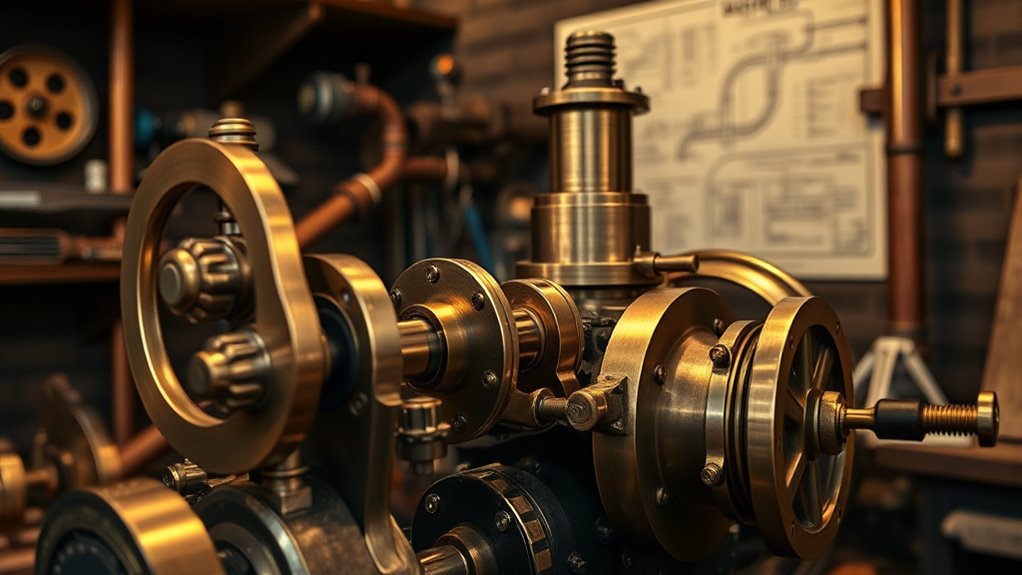
A Stirling engine is a type of heat engine that converts thermal energy into mechanical work through a cyclic process involving the expansion and compression of a gas. Unlike internal combustion engines, Stirling engines operate on an external heat source, which allows for a high level of thermal efficiency. This efficiency stems from their ability to approach the Carnot limit when perfectly optimized, making them attractive for various applications where energy conservation matters. Historically, Stirling engines have seen practical use in a variety of settings, from early 19th-century industrial experiments to specialized applications like submarine propulsion and auxiliary power sources. In the Victorian era, they gained popularity as clean, quiet, and reliable power sources, especially in settings where traditional engines were less suitable or practical.
Your understanding of their historical applications reveals how versatile these engines have been over the centuries. During the 1800s, inventors and engineers explored Stirling engines as potential alternatives to steam and internal combustion engines. They were used in small-scale power generation, pumping, and even in early refrigeration systems. Their ability to run on a variety of heat sources, including solar, biomass, or waste heat, made them particularly appealing. The Victorian period marked a time when innovation thrived, and Stirling engines fit right into that landscape by offering a cleaner and more sustainable option, even if their commercial use was limited by manufacturing constraints at the time.
Today, these engines are experiencing a renaissance among modern makers and engineers interested in sustainable energy solutions. Because they can run quietly and with high thermal efficiency, Stirling engines are ideal for niche applications like renewable energy systems, combined heat and power setups, and experimental green technology projects. Their historical applications serve as proof of their adaptability and potential, inspiring a new generation to revisit and refine this Victorian power technology. By understanding their historical significance and core principles, you can appreciate how Stirling engines combine old-world ingenuity with modern innovation. Whether you’re building a small demonstration model or exploring renewable energy projects, the Stirling engine’s blend of efficiency, versatility, and historical charm offers a compelling, eco-friendly power source that continues to inspire.
Stirling engine kit for beginners
As an affiliate, we earn on qualifying purchases.
As an affiliate, we earn on qualifying purchases.
Frequently Asked Questions
How Efficient Are Stirling Engines Compared to Modern Internal Combustion Engines?
You’ll find that Stirling engines are generally more efficient than modern internal combustion engines, mainly because of their higher efficiency comparison and better fuel consumption. They operate with closed-cycle heat exchange, which reduces energy loss, making them ideal for sustainable projects. While internal combustion engines rely on combustion, Stirling engines use external heat sources, allowing for greater efficiency and lower fuel consumption, especially in low-power or niche applications.
What Are Common Materials Used in Building Small-Scale Stirling Engines?
Imagine building a tiny steam engine—your choice of materials shapes its success. For small-scale Stirling engines, you typically use materials like aluminum for its lightweight and thermal conductivity, brass for durability, and steel for strength. Your fabrication techniques, such as precision machining and brazing, are vital to guarantee tight seals and smooth operation. Material selection directly impacts efficiency and longevity, making your craftsmanship the key to a functional, reliable Stirling engine.
Can Stirling Engines Run on Renewable Heat Sources Like Solar or Biomass?
Yes, you can run Stirling engines on renewable heat sources like solar or biomass, making them a great choice for sustainable heating. By harnessing renewable energy, you reduce reliance on fossil fuels and lower emissions. Solar collectors or biomass burners provide consistent heat, powering your Stirling engine efficiently. This eco-friendly approach lets you explore renewable energy while enjoying the classic, innovative power of Stirling engines in your projects.
What Maintenance Challenges Do Stirling Engines Typically Present?
You’ll find that Stirling engines often face maintenance challenges like lubrication issues and seal deterioration. Surprisingly, seal wear accounts for over 60% of service calls, highlighting its importance. To keep your engine running smoothly, regularly check and replace seals, and ensure proper lubrication. Without proper care, these issues can reduce efficiency and lifespan, so staying vigilant about maintenance ensures your Stirling engine remains reliable and effective.
Are There Commercial Applications of Stirling Engines Today?
Yes, stirling engines find commercial use today, especially in harnessing industrial heat and space applications. You might see them in distributed power generation, where they convert waste heat into electricity efficiently. Space agencies also explore stirling engines for spacecraft power systems due to their reliability and quiet operation. As a renewable energy solution, they offer sustainable, low-maintenance options, making them attractive for modern industries and space missions alike.
small Stirling engine demonstration model
As an affiliate, we earn on qualifying purchases.
As an affiliate, we earn on qualifying purchases.
Conclusion
As you explore Stirling engines, you’ll discover their timeless charm and modern potential. With a bit of Victorian ingenuity, you can harness this ancient yet futuristic technology to power your projects today. Think of it as having your very own steampunk gadget, blending history with innovation. So, grab your toolkit, channel your inner Victorian inventor, and bring these classic engines into the 21st century—proof that sometimes, the past really does fuel the future.
renewable energy Stirling engine
As an affiliate, we earn on qualifying purchases.
As an affiliate, we earn on qualifying purchases.
Stirling engine parts and components
As an affiliate, we earn on qualifying purchases.
As an affiliate, we earn on qualifying purchases.
Fall Picks
fall essentials
As an affiliate, we earn on qualifying purchases.