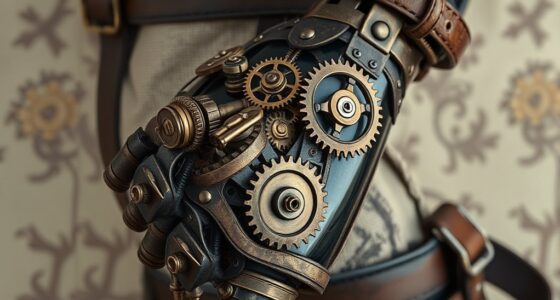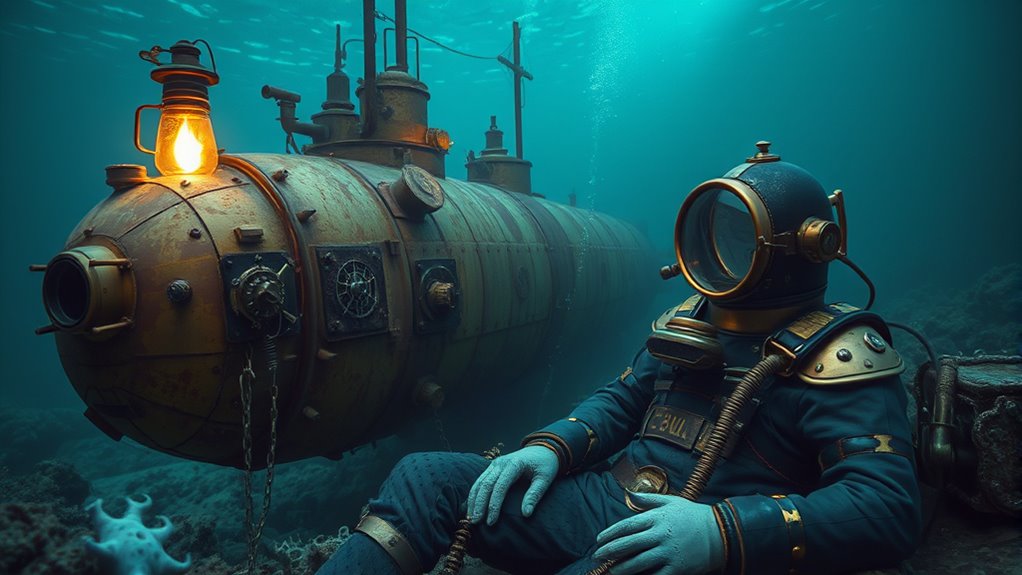

In history, Victorian innovators crafted steam-powered submarines and diving suits that blend intricate mechanical design with daring exploration. These vessels used brass exteriors, valves, and gears, reflecting craftsmanship and industrial ingenuity, while suits featured copper, leather, and glass viewing ports. This era pushed the boundaries of underwater travel, inspiring the steampunk aesthetic we admire today. If you want to uncover more about these fascinating feats of engineering and exploration, there’s much more to discover ahead.
Key Takeaways
- Victorian steampunk combines steam-powered submarines and diving suits with Victorian design elements and mechanical craftsmanship.
- Early submarines featured brass exteriors, complex valves, and steam engines, exemplified by vessels like HMS Holland.
- Diving suits were crafted from copper, brass, and leather, with articulated joints, glass helmets, and steam-powered pumps.
- These innovations expanded underwater exploration, inspiring future marine technology and capturing Victorian ingenuity.
- The aesthetic and engineering of steampunk submarines and suits remain influential, symbolizing human curiosity and mechanical artistry.

Have you ever wondered what a world blending Victorian ingenuity with deep-sea adventure looks like? Imagine a time when explorers pushed the boundaries of marine exploration using steam-powered devices, bridging the gap between science fiction and reality. During the late 19th and early 20th centuries, inventors designed submarines and diving suits that embodied this steampunk spirit, combining intricate machinery, brass fittings, and mechanical ingenuity. These inventions weren’t just tools; they were symbols of human curiosity and ambition, fueled by a desire to uncover the mysteries lurking beneath the ocean’s surface.
Imagine a world where Victorian innovation fuels deep-sea adventures with steam-powered submarines and elegant diving suits.
In those days, marine exploration relied heavily on steam-powered devices. Unlike modern submarines, which run on electricity or nuclear energy, these early submersibles used steam engines to propel themselves through water. Picture a compact vessel with a gleaming brass exterior, complete with gears and valves that hissed and clanked as they operated. These steam-powered submarines, such as the famous “HMS Holland,” showcased Victorian engineering at its finest, allowing explorers to venture deeper than ever before. They often featured complex periscopes, ballast tanks, and pressure-resistant hulls, all driven by intricate mechanical systems. The craftsmanship was both functional and artistic, with polished metal surfaces and ornate controls, giving a sense of adventure and mastery over nature.
Similarly, diving suits of this era reflected the steampunk aesthetic. These suits weren’t simple rubber or neoprene ensembles but elaborate constructs made from copper, brass, and leather. They featured articulated joints, air supply systems powered by hand pumps or small steam engines, and helmets with glass viewing ports. These suits allowed divers to explore underwater environments with a degree of safety and independence previously impossible. The design was often inspired by Victorian fashion and industrial machinery, with exposed rivets, valves, and gauges. Each suit was a marvel of engineering, combining functionality with a sense of style, making the diver look like a steampunk adventurer ready to uncover sunken treasures or study marine life up close.
Throughout history, these steam-powered devices and suits contributed remarkably to marine exploration, pushing the limits of what was possible in underwater travel. While they lacked the efficiency and safety of modern technology, they captured the imagination of their time. Their intricate designs and mechanical complexity evoke a sense of wonder and ingenuity. If you step back and consider these inventions, you see how they embody the spirit of discovery—a blend of Victorian craftsmanship, mechanical innovation, and daring exploration that continues to inspire steampunk enthusiasts today. They remind us that, even in the face of the unknown, human creativity and determination can carve out new frontiers beneath the waves.
Frequently Asked Questions
How Accurate Are Steampunk Submarines Compared to Real Historical Models?
Steampunk submarines are mainly aesthetic, blending Victorian design with imaginative technology, so they aren’t very accurate historically. While they capture the aesthetic accuracy of the era’s style, their technological plausibility is often exaggerated or fictionalized. You’ll find charming vintage details, but the actual capabilities and engineering of these submarines don’t match real historical models. They serve more as creative interpretations than precise representations of actual underwater technology.
What Materials Were Used in Authentic Victorian Diving Suits?
You might be surprised, but Victorian diving suits primarily used waterproof leather and metal rivets to guarantee durability and flexibility underwater. Leather joints allowed for better movement, while metal rivets secured the suit’s structure. The leather was often treated with waterproofing agents, making it resilient against pressure and water. These materials combined to create a practical yet complex design that stood the test of deep-sea exploration.
Did Any Real Underwater Expeditions Influence Steampunk Designs?
Yes, real underwater expeditions like deep sea exploration and nautical legends heavily influenced steampunk designs. You see this in the intricate gearwork and vintage aesthetic, inspired by early submersibles and diving suits used during historic explorations. These adventures captured imaginations, blending science and fantasy, which steampunk celebrates. You can spot this influence in the detailed craftsmanship and retro-futuristic style that pays homage to those daring maritime ventures.
How Did Underwater Technology Evolve During the Steampunk Era?
During the steampunk era, underwater technology evolved with steam-powered propulsion systems and Victorian diving helmets. You see innovations like these, blending Victorian aesthetics with functionality, which inspired steampunk designs. Steam engines drove early submarines, making underwater travel more feasible, while diving helmets provided safer, deeper exploration. These advancements fueled imagination, allowing you to envision a world where steam and gears dominate beneath the waves, shaping the distinct steampunk aesthetic.
Are There Modern Replicas of Steampunk Submarines Still in Use Today?
Yes, modern replicas of steampunk submarines still exist, mainly for enthusiasts and exhibitions. Steampunk enthusiasts often build or restore these replicas to showcase their love for the genre’s aesthetic and history. You might find enthusiasts using these vessels for themed events, parades, or private collections. While not functional for actual underwater exploration, these replicas serve as mesmerizing symbols of steampunk creativity and craftsmanship.
Conclusion
As you explore the fascinating world of underwater steampunk, you realize that these inventions, while charming and inventive, hint at an era’s longing for mastery over the seas. Their intricate designs whisper of dreams and daring spirits, yet also remind us of the delicate balance between innovation and caution. In embracing this history, you appreciate both the wonder and the wisdom it offers, gently guiding you toward a future where curiosity and care go hand in hand.