
TL;DR

Get art and craft supplies delivered free — and shop member deals
- Fast, free delivery on millions of items
- Access to Prime Big Deal Days deals on October 6–7
- Prime Video, Amazon Music and more included
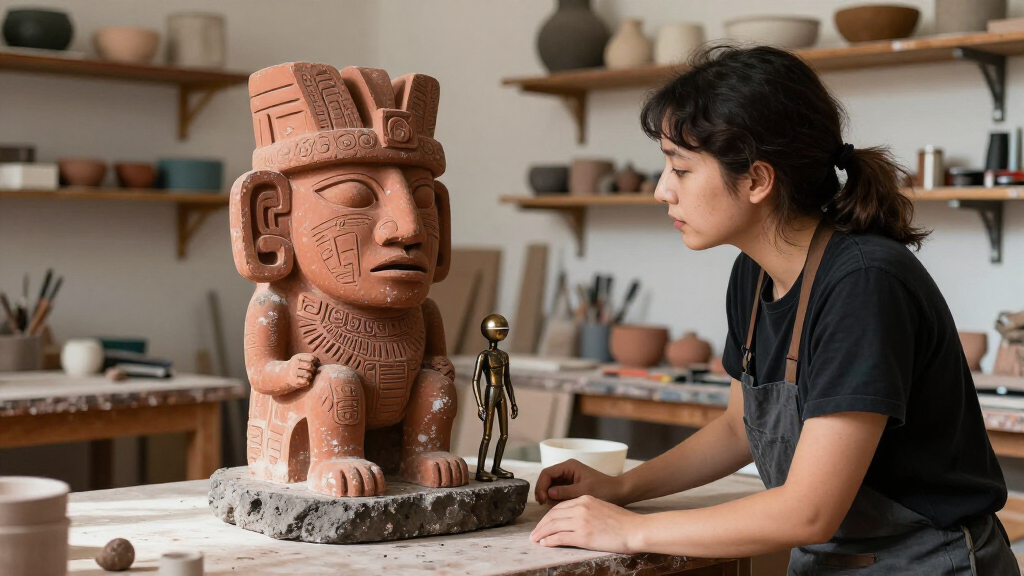
New Mexico-based artist Max Lehman’s exhibition Ancestral Androids is on view at Hecho a Mano in Santa Fe through Nov. 1, 2026. Its ceramic sculptures connect references to ancient visual culture with imagined robots and questions about archaeology, artificial intelligence and what future generations may know.
New Mexico-based artist Max Lehman is presenting Ancestral Androids, an exhibition of ceramic sculptures at Hecho a Mano in Santa Fe through Nov. 1, 2026. The works combine visual references to ancient cultures with imagined robotic figures, using a speculative future-archaeology premise to raise questions about how objects acquire meaning when their makers and original purposes are no longer known.
The sculptures are made from ceramic, with some pieces finished using acrylic and metallic paint. Works named in the exhibition include Petro who is Predicting the Unpredictable, The Malachite Mage, The Duchess of Digital Data and The Sapphire Sage, all dated 2026. Other titles include Mayan Max and His Pre-Colo iPad and Fiery Phineas and His Tablet of Doom.
Colossal’s report describes the figures as vividly colored, cartoonish characters whose expressions can seem unsettling. Some have additional faces on their foreheads or bellies. The imagery draws on ancient sculpture and sacred figures while placing those references alongside technology and science-fiction ideas; the report does not identify the characters as depictions of specific archaeological objects.
Lehman frames the sculptures as artifacts that might be excavated in a distant future, after their origins and functions have been forgotten. The exhibition pairs that imagined scenario with questions about the scale of today’s archives and how artificial intelligence could affect which accounts survive or are treated as fact. Those questions are presented as themes of the work, not as predictions about particular future technologies.
Imagining Future Archaeological Evidence
The exhibition makes a contemporary art question legible through a familiar archaeological problem: people reconstruct the past from incomplete material evidence. Lehman’s imagined future shifts that problem forward, asking viewers to consider how a later society might interpret today’s technologies if their context were lost. The sculptures’ hybrid references leave room for uncertainty rather than supplying a single explanation.
The works also connect that speculation to present-day concerns about artificial intelligence, data and authorship. Lehman says his practice depends on the physical process of shaping clay, which he sees as carrying evidence of the maker’s gestures and experience. That is his account of his own medium and process; it does not establish a general limit on what machines can produce.
As an affiliate, we earn on qualifying purchases.
Ancient Forms, Future Artifacts
Lehman studies Pre-Columbian art history, according to Colossal, and the report points to carved Maya temple slabs and the Mexica Sun Stone as examples of ancient visual culture. The exhibition uses this background as a point of reference for a speculative body of work, rather than claiming that its new sculptures are archaeological objects or historically authentic replicas.
In a statement quoted by Colossal, Lehman says he avoids giving complete explanations because archaeology rarely offers certainty. He describes interpretation as a process of rebuilding civilizations from fragments and filling gaps left by time. That approach informs the show’s premise: the figures are presented as possible remnants of a future culture whose meanings are no longer readily available.
“I resist providing complete explanations because archaeology rarely offers certainty.”
— Max Lehman, in a statement quoted by Colossal
artificial intelligence themed sculptures
As an affiliate, we earn on qualifying purchases.
As an affiliate, we earn on qualifying purchases.
Questions the Exhibition Leaves Open
The source report does not provide details about the exhibition’s full schedule, admission arrangements, or whether any related events are planned. It also does not establish whether the works draw on particular archaeological finds beyond the broad visual and historical references described. Lehman’s statements about archaeology, clay and AI are his interpretations of his work, not independently verified conclusions about those fields.
The exhibition’s future setting is imaginative rather than a claim about what later archaeologists will discover. Which information will survive, how future people might interpret it, and how AI may shape historical accounts remain open questions raised by the work.
Pre-Columbian style ceramic figures
As an affiliate, we earn on qualifying purchases.
As an affiliate, we earn on qualifying purchases.
Exhibition Runs Through November 1
Ancestral Androids remains on view at Hecho a Mano in Santa Fe through November 1, 2026, according to Colossal. The supplied report does not list further dates or programming. Readers seeking additional images can view Lehman’s work through the artist’s Instagram, as noted in the report.
science fiction inspired art sculptures
As an affiliate, we earn on qualifying purchases.
As an affiliate, we earn on qualifying purchases.
Key Questions
Where is Max Lehman’s Ancestral Androids exhibition?
The exhibition is at Hecho a Mano in Santa Fe, New Mexico, according to Colossal’s report.
How long is the exhibition on view?
Colossal reports that Ancestral Androids continues through Nov. 1, 2026. The source does not give additional scheduling details.
What materials did Lehman use?
The works described in the report are ceramic, with some using acrylic and metallic paint. Several pieces are identified as glazed ceramic.
What is the exhibition about?
The sculptures imagine technology-inspired figures as artifacts from a distant future. Lehman uses that premise to explore archaeological interpretation, memory, AI and the survival of information.
Does the exhibition make claims about what AI will do?
No specific prediction is confirmed in the report. The show raises questions about how AI could affect which stories are preserved or treated as fact, while Lehman offers his own views about human making and ceramic work.
Source: rss
Fall Picks
fall essentials
As an affiliate, we earn on qualifying purchases.