TL;DR

Get art and craft supplies delivered free with Prime
- Fast, free delivery on millions of items
- Prime Video, Amazon Music and more included
- Member-only deals all year
Edward Hopper began work on Nighthawks by late November 1941 and completed the painting in 1942; it is now held by the Art Institute of Chicago. A Literary Hub report describes his sketches and models and reviews competing theories about the diner’s inspiration. No single Greenwich Avenue location has been established as its source.
Edward Hopper had begun Nighthawks by late November 1941, months before the painting entered the Art Institute of Chicago’s collection in 1942, according to a Literary Hub report examining its creation and possible sources. The report describes preparatory sketches and modeling by Hopper and his wife, Josephine, while noting that the New York diner that inspired the scene has not been identified with certainty.
In November 1941, photographer Arnold Newman photographed Hopper in front of an empty canvas, the report says. Hopper had settled on the painting’s broad dimensions and had likely completed many of the 19 preparatory sketches, made in pencil and chalk. Some sketches include numerical notes about enlarging the composition. The finished oil painting measures 33 1/8 by 60 inches and is dated 1942.
Hopper made trips to the Dixie Kitchen diner in Midtown to sketch objects including coffee urns, cups, salt and pepper shakers, and napkin dispensers. For the figures, he used a full-length mirror to model the two suited men, while Josephine Hopper, known as Jo, posed for the auburn-haired woman in burgundy. The report says Hopper invented the blond counterman; Jo reportedly remarked that he resembled “practically Capt. Ed Staples.”
The painting is in the Art Institute of Chicago, which acquired it in 1942 using funds from the Friends of American Art. Hopper said the diner was suggested by a restaurant at a Greenwich Avenue street junction and described the scene as “the way I think of a night street.” Those remarks point toward a source but do not settle its identity: the report notes that Hopper altered or invented key features, including the diner’s sweeping curved glass window.
A New York Diner, Reimagined
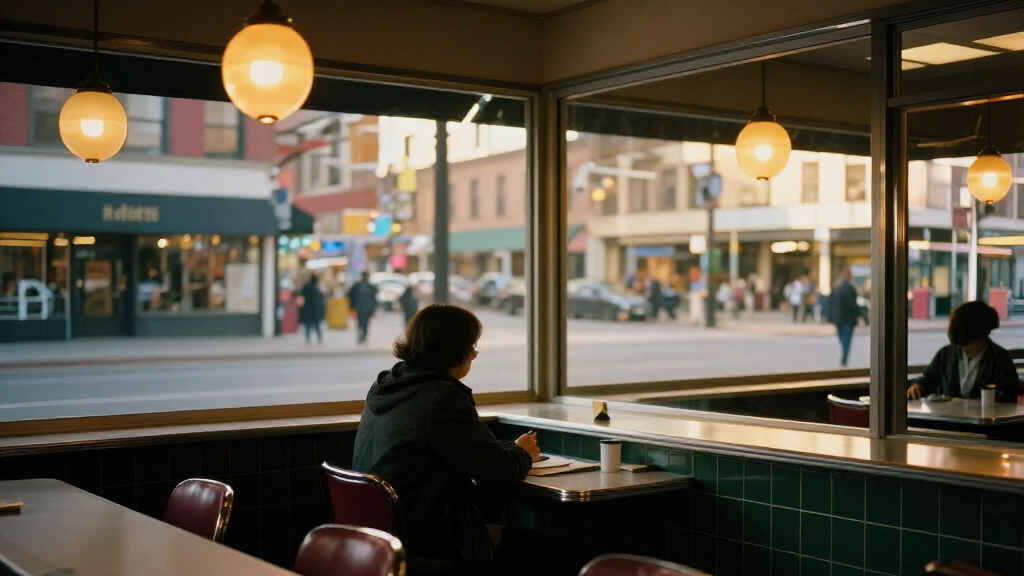
Nighthawks is recognized for its brightly lit diner, isolated customers, and contrast between the interior and the street. The report examines Hopper’s process alongside efforts to identify a real-world model for the setting. The painting’s diner may combine observed details with invented features, rather than depict one identifiable restaurant.
Hopper planned the painting before Japan’s attack on Pearl Harbor on December 7, 1941, and completed it in 1942. The report discusses the work in the context of the wartime period, but does not establish that Hopper intended it as a direct statement about the war.
Popular right now

Samsung 50-inch QN70H Neo QLED 4K Smart TV with Austere 2.5 m 8K HDMI Cable

Ninja CREAMi XL Deluxe 11-in-1 Ice Cream and Frozen Treat Maker with Two 24 oz. Tubs

KitchenAid Classic Series 4.5-Quart Tilt-Head Stand Mixer, Onyx Black
As an affiliate, we earn on qualifying purchases.
From Greenwich Avenue to Canvas
Hopper’s reported comment about a Greenwich Avenue restaurant has prompted attempts to locate the source. Suggested candidates include a wedge-shaped site at 70 Greenwich Avenue, which was a newsstand in Hopper’s time, and Riker’s, a restaurant near the junction of West Fourth Street and Seventh Avenue South where the Hoppers often ate. Neither has been established as the definitive model.
Art historian Carter Foster identified Crawford Lunch, once near Greenwich Avenue and Twelfth Street, as the likeliest source in 2013, according to the report. A “Lunch” sign in one of Hopper’s late studies and the premises’ shape support that possibility. But the curved glass frontage, Art Deco appearance, and cigar advertisement in the finished painting do not match the proposed sites in all respects. The report suggests Hopper may have combined features from several places, perhaps drawing the distinctive glass-fronted form from New York architecture such as the Flatiron Building.
Wartime conditions form another part of the timeline. After Pearl Harbor, New York residents faced blackouts and fears of attacks on the city. In a December 17 letter to Marion Hopper, Jo described their exposed skylights, her preparations for an emergency, and Edward’s reluctance to take precautions. She also wrote that he was absorbed in a new canvas while their gallery, the Rehn Gallery, considered moving paintings to storage.
““Nighthawks seems to be the way I think of a night street.””
— Edward Hopper, as quoted in the Literary Hub report
The Diner’s Source Remains Open
No confirmed address for the diner is established in the supplied report. Crawford Lunch is presented as a strong candidate, not a proven source, and other Greenwich Avenue locations have also been proposed. The report’s account of Hopper’s changes to the setting supports the possibility that the finished diner drew on several references rather than one exact building.
The available material does not establish a definitive meaning for the painting’s figures or emotional atmosphere. Connections between its isolation and artificial light and wartime tension are interpretations. The chronology is clear—the work was underway before Pearl Harbor and completed in 1942—but the sources provided do not document a direct statement by Hopper tying the painting’s meaning to the attack or the war.
Further Evidence, Not a Final Address
The supplied report describes a continuing art-historical investigation rather than a newly announced discovery. Further archival evidence, photographs, or documentation about the candidate restaurants could strengthen or weaken particular theories, but no new identification is confirmed here. The report traces the painting’s development through Hopper’s sketches, reported visits, and Jo’s letters, while leaving the precise origin of its diner unresolved.
The work is part of the Art Institute of Chicago’s collection. Readers seeking the painting should check the museum’s latest collection information; the source material does not provide exhibition dates or confirm its present gallery location.
Key Questions
When did Edward Hopper paint Nighthawks?
Hopper had begun the work by late November 1941. The finished oil painting is dated 1942.
Where is Nighthawks held?
The painting belongs to the Art Institute of Chicago, which acquired it in 1942 using funds from the Friends of American Art.
Was Nighthawks based on a real diner?
Hopper said the scene was suggested by a restaurant at a Greenwich Avenue street junction. The exact location is unsettled. Crawford Lunch has been proposed as the likeliest source, but the report does not establish it as fact.
Who modeled for the figures?
Hopper reportedly used himself as a model for the two suited men and Jo Hopper for the auburn-haired woman. The report says he invented the blond counterman.
Did the attack on Pearl Harbor influence the painting?
Hopper began planning the work before the December 7, 1941, attack, and completed it during the wartime period that followed. The report discusses that historical setting, but the supplied material does not confirm that Hopper intended the painting as a direct response to Pearl Harbor.
Source: lithub.com