TL;DR

Get art and craft supplies delivered free — and shop member deals
- Fast, free delivery on millions of items
- Access to Prime Big Deal Days deals on October 6–7
- Prime Video, Amazon Music and more included
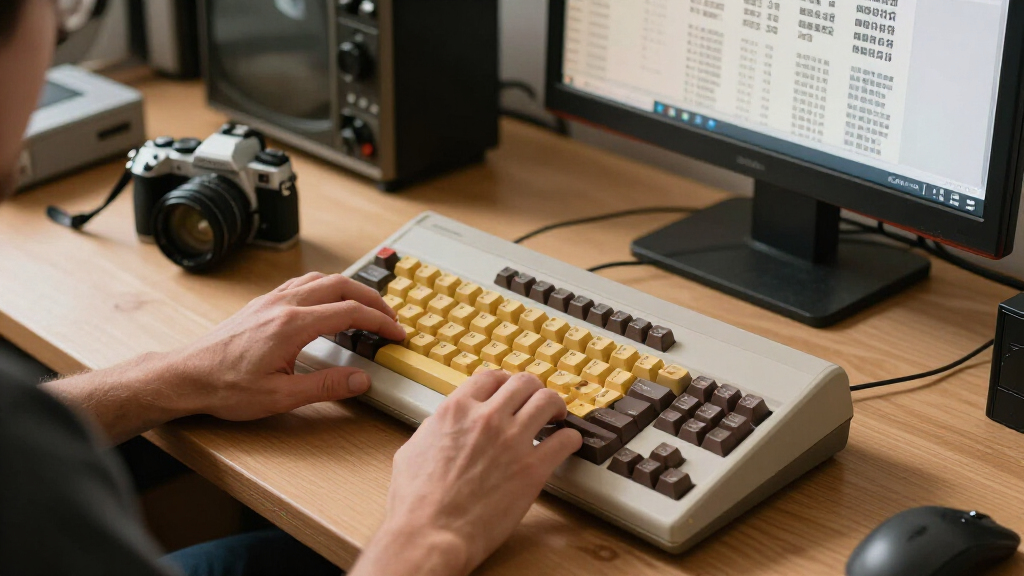
Levente Szabadkai has published C64 Keyboard, a typeface built from photographs of keycaps on his Central European Commodore 64. It includes letters, numbers, selected accented characters, function-key labels and reconstructed PETSCII front legends; the project is an unofficial recreation, not the C64 screen bitmap font.
Levente Szabadkai has released C64 Keyboard, a font that recreates lettering from photographs of keycaps on his Central European Commodore 64. The downloadable typeface includes the keys’ printed legends and reconstructed PETSCII graphics, offering users a way to reproduce the look of the physical keyboard rather than the computer’s familiar screen characters.
The project’s GitHub page offers TTF, OTF and webfont files, as well as a complete package with an online preview and a local preview page. Users can install the font and select “C64 Keyboard” in an application. In the preview, clicking a function-key or PETSCII button inserts its symbol into a type tester, from which users can copy the text. The copied symbols rely on this font to display correctly.
The character set includes uppercase letters, numbers, punctuation, arrows, the pound sign and pi, along with selected accented letters, including Hungarian characters. It also has f1–f12 labels and all 63 PETSCII graphic front legends, arranged by key in the preview. Lowercase input displays as uppercase. The project says users with an earlier version should replace it with version 1.112 and restart applications that continue to show the old font.
Szabadkai describes the design as a recreation of the printed key legends, with cleaned-up shapes and consistent proportions. The PETSCII graphics are reconstructed outlines, not exact traces of the photographs: their identities and key assignments follow the Ultimate Commodore 64 Reference, while details such as curves, frame thickness and print proportions are inferred from the keyboard image. The repository provides editable outlines in its glyphs directory and build tools in scripts.
A Typeface for Physical C64 Keys
The font gives designers, hobbyists and Commodore 64 enthusiasts a practical way to use the keyboard’s printed lettering in modern applications. Its focus on the physical keycaps distinguishes it from a font based on the C64’s on-screen bitmap characters, which represent a different part of the machine’s visual identity.
The inclusion of PETSCII front legends also makes the key labels usable as text in supported applications, though displaying copied symbols correctly depends on having this font installed. The project’s preview and encoding guide offer a route for finding and inserting those characters, while its editable outlines let users inspect the source shapes.
As an affiliate, we earn on qualifying purchases.
Photographs as the Reference
The source material is Szabadkai’s own keyboard, described in the repository as a Central European Commodore 64. Its keycaps serve as the reference for the letters, numbers and symbols. For the PETSCII front legends, the project combines an established reference for character identities and key assignments with visual estimates from the keyboard photograph.
The distinction matters: this is an independent interpretation of printed legends, not a pixel font or a claim of exact photographic tracing. The repository identifies the work as an unofficial reconstruction and says it is not endorsed by Commodore. The close-up photographs used as references are not included in the download.
““This recreates printed key legends … rather than the screen bitmap font.””
— Levente Szabadkai, project author
As an affiliate, we earn on qualifying purchases.
Limits of the Reconstruction
The repository does not give measurements for how closely the reconstructed shapes match the original printed legends, or describe an independent review of their accuracy. It says that PETSCII frame thickness, curves and print proportions were inferred from a photograph, so those details should be understood as reconstruction choices.
The project also does not include the reference photographs. Its CC0 dedication applies to rights Szabadkai holds in the font and project materials; the repository says it does not grant rights others may hold in historical keycap designs or trademarks. The page does not establish the status of any particular use of those designs.
As an affiliate, we earn on qualifying purchases.
Try the Preview or Install
Readers can try the online preview or download the package and open preview.html to test the characters. The repository also provides separate TTF, OTF and webfont downloads. Users who already have an older release should install version 1.112 and restart applications that retain the previous font.
The GitHub page includes a PETSCII key map and encoding guide for character codes and keyboard combinations. It does not announce a release schedule or describe planned additions, so further updates remain unspecified.
As an affiliate, we earn on qualifying purchases.
Key Questions
What does the C64 Keyboard font recreate?
It recreates printed legends on Commodore 64 keycaps, using photographs of the project author’s keyboard as a reference. It is not the C64’s screen bitmap font.
Which characters are included?
The font includes uppercase letters, numbers, punctuation, arrows, £, π, selected accented letters, f1–f12 labels and 63 PETSCII graphic front legends. Lowercase input displays as uppercase.
How can I use the PETSCII symbols?
Use the online preview or the package’s preview.html to insert symbols into the type tester, then copy them into an application with C64 Keyboard selected. The copied symbols need the font to display correctly.
Is the reconstruction an exact trace of the keycaps?
No. The project says the PETSCII outlines are reconstructed, with some print proportions and shapes inferred from a keyboard photograph. They are not exact photo traces.
What license does the project use?
Szabadkai dedicates the rights he holds in the repository’s contributions to the public domain under CC0 1.0 Universal. The project notes that this does not grant rights others may hold in historical keycap designs or trademarks.
Source: hn
Evergreen bestsellers Picks
bestsellers
As an affiliate, we earn on qualifying purchases.