
TL;DR

Get art and craft supplies delivered free with Prime
- Fast, free delivery on millions of items
- Prime Video, Amazon Music and more included
- Member-only deals all year
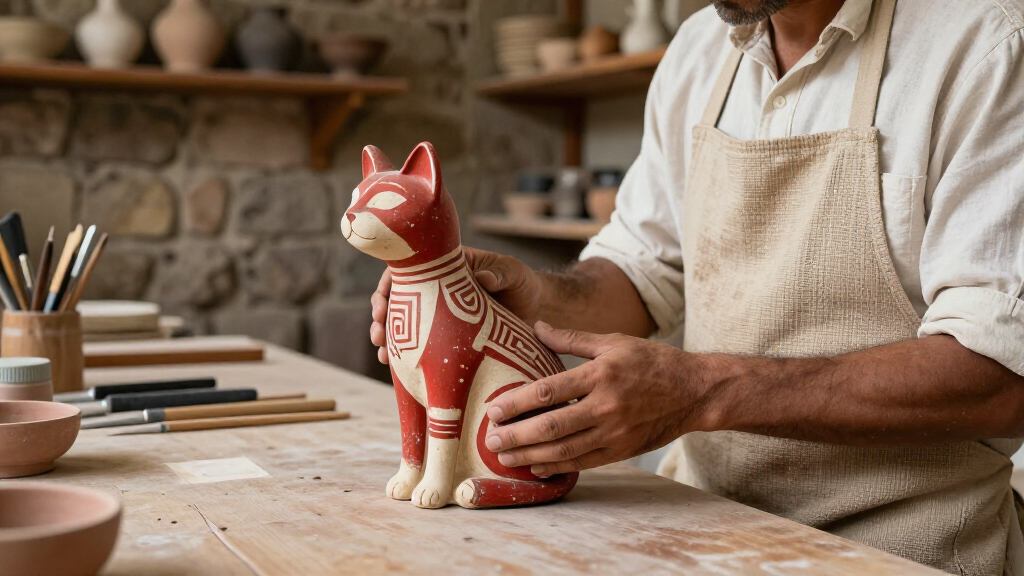
A post on media.piefed.world presents an image it identifies as a cat-shaped vessel from Peru, dated approximately 200–700 CE. The post provides no details about the vessel’s maker, archaeological findspot, current location or the basis for the dating, so its history cannot be independently established from that source alone.
A post on media.piefed.world identifies an image as a cat-shaped vessel from Peru, dating it to about 200–700 CE. The post’s image and caption do not identify the object’s maker, archaeological findspot, present collection or the evidence used to assign the date.
The media.piefed.world post is titled “Cat-Shaped Vessel from Peru, c.200-700.” Its title presents the object as a vessel shaped like a cat and places it within a broad period of roughly five centuries. The date is an approximate label in the post; the source does not explain how it was determined.
The post links to a WebP image, but provides no accompanying museum entry, excavation record, scholarly publication or statement from an archaeologist. The image and caption therefore support reporting what the post identifies, but do not independently establish the object’s cultural attribution, provenance or interpretation.
The post and image provide no information about the vessel’s size, materials, manufacturing technique, intended use, condition or ownership. They also do not clarify whether the image shows an archaeological object in a collection, a reproduction, or an image reproduced from another source. Those distinctions matter when assessing an ancient object’s history and the reliability of its attribution.
What the Object’s Attribution Can Tell Us
Animal-shaped vessels can invite readers to ask how people represented animals and what roles such objects served. But the media.piefed.world caption alone cannot answer those questions for this particular piece. Without reliable information about its findspot, material and archaeological setting, claims about its original purpose or cultural meaning would go beyond the evidence provided by the post.
The post may introduce readers to an object they have not seen before, while also showing why provenance and documentation matter. A verified collection record or research source could connect the vessel to a place, period and community. Until such supporting information is available, the soundest account is limited to what the post states: it labels the image as a cat-shaped vessel from Peru and gives an approximate date.
Popular right now

Dyson Airwrap i.d. Multi-Styler for Straight and Wavy Hair

Shark Rocket Corded Stick Vacuum (HV301) – Gray/Orange

De'Longhi Rivelia Automatic Espresso Machine with Milk Frother
As an affiliate, we earn on qualifying purchases.
A Broad Date, Not a Full History
The media.piefed.world post labels the object “c. 200–700.” The abbreviation “c.” signals an approximate date, and the range spans several centuries. The post does not say whether the estimate comes from excavation context, stylistic comparison, scientific testing or another method. Its date should not be treated as proof that the object was made in any single year or that its origin has been independently confirmed.
Likewise, “from Peru” is the post’s geographic description, but it does not establish where the vessel was excavated or whether it has a documented chain of ownership. For archaeological objects, a record of where an item was found and how it entered a collection can shape what researchers can responsibly say about it. The supplied post includes no such record and names no museum or other holding institution.
Provenance and Dating Remain Unverified
The supplied media.piefed.world post does not identify the person or institution responsible for the attribution, or provide documentation for the Peruvian origin and c. 200–700 date. It also gives no chain of custody, excavation details or current location. These details remain unconfirmed on the basis of the supplied post, rather than necessarily being unknown to researchers or a holding institution.
The post and image leave further questions unanswered, including what the vessel is made from, whether the cat form is complete, and whether the object is an original or a reproduction. The supplied material offers no expert comment or direct quotation, so no specialist interpretation can be attributed. The image alone is not enough to resolve these points.
Documentation Needed to Confirm the Attribution
The media.piefed.world post mentions no follow-up, exhibition announcement or research release. The next useful step would be to locate the image’s original publication or a catalogue entry from a museum or research institution. Such documentation could clarify the object’s collection, provenance, physical description and the basis for its dating.
Until a more detailed source is available, readers should treat the caption as an identification made by the post, not as a fully documented archaeological account. Any later reporting should update the attribution if an authoritative record or expert assessment becomes available.
Key Questions
What is the reported object?
The media.piefed.world post identifies the image as a cat-shaped vessel from Peru. It does not provide a detailed description or independent confirmation of that identification.
When is the vessel said to date from?
The post’s caption gives an approximate date of c. 200–700 CE. It does not explain the dating method or identify a more specific date.
Where was the vessel found?
The post describes it as being from Peru, but does not name an archaeological site or provide an excavation record. A specific findspot cannot be established from the post alone.
Where is the vessel now?
The post does not identify a museum, collection or owner. Its current location is not stated in the material provided.
What was the vessel used for?
The post gives no information about the vessel’s original function. Without a documented object description and archaeological context, a specific use cannot be responsibly assigned.
Source: fediverse