
TL;DR

Get art and craft supplies delivered free — and shop member deals
- Fast, free delivery on millions of items
- Access to Prime Big Deal Days deals on October 6–7
- Prime Video, Amazon Music and more included
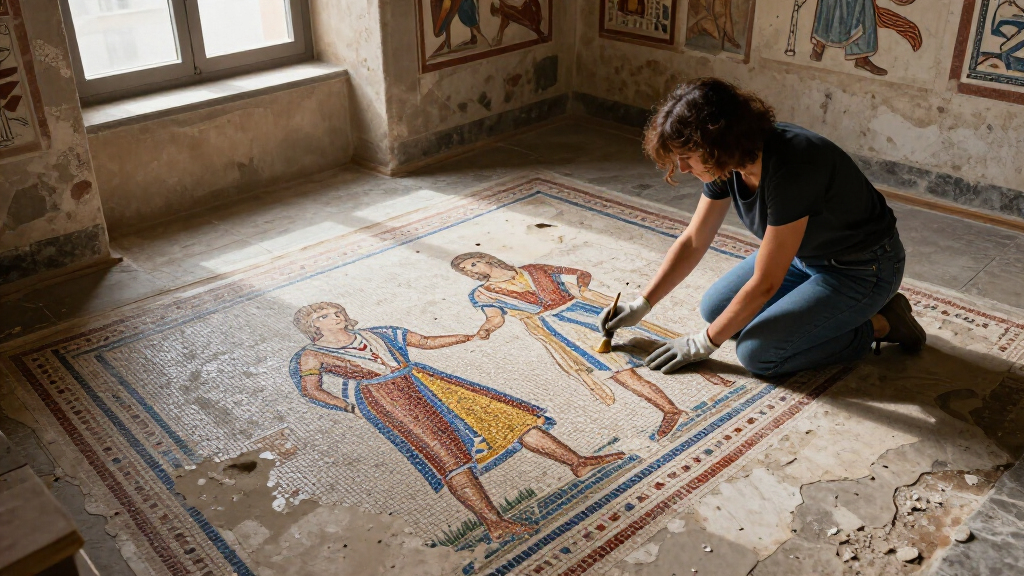
Rome has opened the underground gallery of the Baths of Trajan as the Museo delle Terme di Traiano. Its main displays include what the source report identifies as the largest surviving wall mosaic in the Roman world, preserved in place in a gallery beneath the ancient baths.
Rome has opened the underground gallery beneath the Baths of Trajan as the Museo delle Terme di Traiano, giving visitors access to what Hyperallergic describes as the largest surviving wall mosaic in the Roman world. The mosaic remains displayed in place in the ancient space, which was uncovered during excavations in the late 1990s.
The gallery runs for about 230 feet (70 meters) beneath the ruins of the baths on Rome’s Oppian Hill. It contains two prominent ancient artworks, including the large mosaic arranged across two sides of a hall. The report also notes an unusual fresco, but provides limited detail about its imagery or date.
At the entrance, a room to the right serves as a small bookshop. On the left, an irregular ancient room displays the museum’s objects directly connected to the baths: eight large lead pipes bearing the words “THERM TRAIANI” in raised lettering. Most of the gallery, however, is given over to the in situ presentation of the mosaic and fresco.
The two artworks have no clear relationship to each other, according to the report, and the article says they have no comparable examples elsewhere in the Roman Mediterranean. The source does not supply a precise date, maker, or detailed interpretation for either work.
A Mosaic Preserved Beneath Trajan’s Baths
The opening brings an artwork that had been found underground into public view while keeping it in its original setting. Visitors can see the mosaic as part of an ancient architectural space, rather than solely through objects removed and placed in a gallery. The report’s description of it as the largest surviving Roman wall mosaic gives the display particular significance, while its unusual setting connects it to the layers of construction and reuse beneath the baths.
The gallery also broadens the story visitors encounter at the site. The Oppian Hill is known for remains of Trajan’s enormous public baths and for the buried rooms of Nero’s Domus Aurea. The newly opened space adds another archaeological discovery beneath the same landscape, though the report does not establish a direct connection between the mosaic and either imperial complex.
Top picks for "breathtak sight ancient"
As an affiliate, we earn on qualifying purchases.
Buildings Buried Beneath Oppian Hill
About 2,000 years ago, the Oppian Hill was a densely built part of Rome. Emperor Trajan later cleared the area to make a platform for his public baths, which were inaugurated in 109 CE. That construction buried a series of earlier buildings beneath the site.
Some of the buried architecture includes richly decorated rooms associated with Nero’s Domus Aurea, or “Golden House,” which can be visited as an immersive experience. The gallery now used by the museum was brought to light in excavations between 1997 and 1999. Rome has since opened it to visitors as the Museo delle Terme di Traiano.
““the largest surviving wall mosaic in the Roman world””
— Hyperallergic report
What the Display Does Not Establish
The source report does not identify the mosaic’s precise date, artist, subject, or original function. It also gives no detailed account of the unusual fresco, including its imagery or how it relates to the buried buildings. Although the article calls the mosaic the largest surviving wall mosaic in the Roman world, it does not provide measurements or explain how that comparison was established.
The relationship between the gallery’s artworks and nearby remains, including the Baths of Trajan and Nero’s Domus Aurea, is also not established in the available account. Further interpretation may be presented by the museum, but the source does not describe any curatorial plans or future research.
Visitors Can Explore the Opened Gallery
The immediate next step is public access to the newly opened museum gallery, where visitors can view the mosaic, fresco, and lead pipes on site. The source report does not give opening hours, admission details, or a schedule for additional displays, so those practical details should be checked with the museum or city of Rome before a visit.
No future excavation, conservation project, or further museum announcement is specified in the report. For now, the opening makes the gallery itself the next point of interest: a newly accessible underground space preserving artworks uncovered during the 1990s excavations.
Key Questions
Where can visitors see the mosaic?
At the Museo delle Terme di Traiano, in an underground gallery beneath the ruins of the Baths of Trajan on Rome’s Oppian Hill.Why is the mosaic notable?
Hyperallergic describes it as the largest surviving wall mosaic in the Roman world. The report does not give its dimensions or explain the basis for the comparison.When was the gallery uncovered?
The gallery came to light during excavations carried out between 1997 and 1999.What else is displayed in the gallery?
The gallery also contains an unusual fresco. In a nearby room, visitors can see eight large lead pipes marked “THERM TRAIANI,” which the report identifies as the objects in the museum most directly connected to the baths.Are the mosaic and fresco connected to the Baths of Trajan?
The report says the two artworks have no clear relationship to each other. It does not establish a direct connection between them and the baths.Source: rss
Fall Picks
fall essentials
As an affiliate, we earn on qualifying purchases.