

Ada Lovelace is known as the world’s first computer programmer because she created the earliest algorithm intended for machine execution. She worked with Charles Babbage’s Analytical Engine, conceptualizing it as a symbolic manipulator rather than just a calculator. Her work included designing instructions—what we now call a program—that could guide the machine’s actions. If you keep exploring, you’ll discover how her innovative ideas laid the foundation for modern programming and software development.

Get art and craft supplies delivered free with Prime
- Fast, free delivery on millions of items
- Prime Video, Amazon Music and more included
- Member-only deals all year
Key Takeaways
- Ada Lovelace is credited with creating the first algorithm intended for Charles Babbage’s Analytical Engine.
- She envisioned machines manipulating symbols and executing coded instructions, laying groundwork for programming concepts.
- Lovelace translated and expanded Babbage’s ideas, including her notes that described how to program the machine.
- Her work demonstrated that machines could be programmed to perform complex tasks beyond simple calculations.
- As the first computer programmer, her contributions significantly influenced the development of software and computational theory.
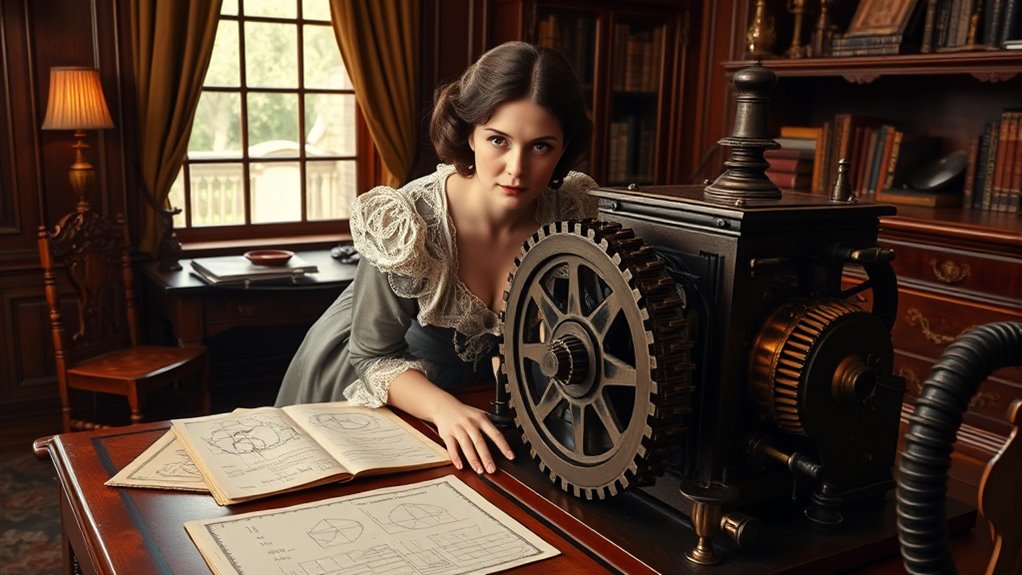
Ada Lovelace, a brilliant mathematician and writer, is often celebrated as the world’s first computer programmer. Her work stands out in the history of mathematics, especially within the broader context of mathematics history, where her innovative thinking bridged the gap between theoretical calculation and practical computing. During her lifetime, the concept of programming was virtually nonexistent, yet her insights laid the groundwork for what we now call early programming. She recognized that machines like Charles Babbage’s Analytical Engine could do more than just crunch numbers—they could manipulate symbols, follow instructions, and perform complex tasks. This foresight marked a significant departure from the prevailing views of machines as mere calculation tools.
Ada Lovelace envisioned machines as symbolic manipulators, laying the foundation for modern programming and computational creativity.
As you explore her contributions, you’ll see how her understanding of the Analytical Engine’s potential was revolutionary. While many of her contemporaries saw machines as limited, Lovelace envisioned a future where these devices could execute a sequence of operations based on coded instructions. She translated and expanded upon Babbage’s ideas, adding her own notes and insights that demonstrated a clear grasp of how algorithms could be used to direct a machine’s actions. Her notes included the first algorithm intended for implementation on a machine, which is why she’s often credited as the first programmer.
In the early programming of the Analytical Engine, Lovelace’s work exemplified a forward-thinking approach that’s still relevant today. She understood that programming wasn’t just about inputting data; it was about designing sequences of instructions that a machine could follow to achieve specific results. Her annotations illustrated how to encode these instructions and how to think about machines as programmable entities rather than static calculators. This realization is fundamental to understanding the evolution of programming languages and the concept of software. Additionally, her recognition of the computational potential of machines laid a foundation that influenced future developments in computer science.
Lovelace’s contributions also helped shift the perception of machines from simple calculation devices to potential creators of art, music, and complex scientific work. Her insights into the machine’s ability to manipulate symbols paved the way for the development of computer science. Today, her name is synonymous with pioneering ideas in early programming, and her work continues to inspire generations of programmers and mathematicians. Recognizing her role in this history emphasizes how her innovative spirit transformed the way we think about computation, making her a true trailblazer in the ongoing story of mathematics history and early programming.
As an affiliate, we earn on qualifying purchases.
Frequently Asked Questions
How Did Ada Lovelace Influence Modern Computer Science?
You can see Ada Lovelace’s influence in modern computer science through her early ideas on algorithm design and computational theory. She recognized that machines could do more than calculations—they could follow complex sequences of instructions. Her work laid the groundwork for programming languages and software development, inspiring generations of computer scientists. By understanding her contributions, you appreciate how her vision helped shape the technology that powers today’s digital world.
What Challenges Did Ada Face as a Female Scientist?
You face challenges as a female scientist due to gender bias and societal expectations that often limited women’s opportunities. Ada Lovelace encountered skepticism from her peers and societal norms that undervalued women’s intellectual contributions. Despite these obstacles, she persisted, demonstrating resilience and passion for her work, ultimately paving the way for future generations of women in science and technology. Your determination can overcome these barriers and inspire change.
Are There Any Living Descendants of Ada Lovelace?
You might be interested to know that Ada Lovelace has living relatives today. For example, her family lineage includes distant descendants through her children, although they are private individuals. While there’s no widely publicized record of direct, prominent living relatives, some genealogical research suggests that her family continues through extended relatives. So, yes, there are likely living relatives, but they tend to keep a low profile.
How Accurate Are the Early Descriptions of Her Work?
The early descriptions of her work are generally quite accurate, but they sometimes reflect interpretation biases of the time. You should know that historical accuracy varies depending on the source, and some details might be simplified or romanticized. When you examine her work today, you’ll find that modern scholarship offers a clearer understanding, helping you interpret her contributions more precisely and appreciate her true role in early computing history.
Did Ada Lovelace Collaborate With Other Pioneering Scientists?
Imagine a symphony where each instrument plays a crucial role; you see, Ada Lovelace did collaborate with pioneering scientists, forming essential scientific partnerships. These collaborative efforts allowed her to exchange ideas, refine her work, and push the boundaries of early computing. Her partnerships with Charles Babbage and others acted like a chorus that amplified her innovative visions, demonstrating how teamwork accelerates groundbreaking discoveries.
computer programming kits for kids
As an affiliate, we earn on qualifying purchases.
As an affiliate, we earn on qualifying purchases.
Conclusion
As you step back from Ada Lovelace’s story, you realize she didn’t just write a program; she planted a seed that grew into the vast forest of modern computing. Her vision turned a mechanical marvel into a creative tool, like a painter with a blank canvas. Remember, her pioneering spirit lights the way, reminding you that even the smallest spark of imagination can ignite a revolution in technology.
As an affiliate, we earn on qualifying purchases.
history of computer programming DVD
As an affiliate, we earn on qualifying purchases.
As an affiliate, we earn on qualifying purchases.
Columbus Day / Indigenous Peoples' Day Picks
long weekend sales
As an affiliate, we earn on qualifying purchases.