

The invention of the telephone revolutionized how you communicate by turning days of letter writing into instant voice conversations. Alexander Bell’s device captured sound and sent electrical signals over wires, making real-time talking possible. This breakthrough transformed personal and business interactions, leading to the complex networks we rely on today. If you’d like to explore how Bell’s invention shaped modern telecommunications and changed the world, there’s much more to discover.
Listen free for 30 days with Audible
Thousands of audiobooks and originals — cancel anytime.
As an affiliate, we earn on qualifying purchases.
Key Takeaways
- Alexander Bell invented the telephone in 1876, enabling voice communication over long distances for the first time.
- The device converts sound waves into electrical signals, transmitting them through wires to be reconverted into sound.
- Bell’s invention revolutionized communication, allowing instant voice conversations and connecting people across cities and countries.
- It laid the foundation for modern telecommunications, leading to innovations like mobile phones and the internet.
- The telephone transformed global connectivity, making communication faster, more accessible, and significantly impacting social and business life.
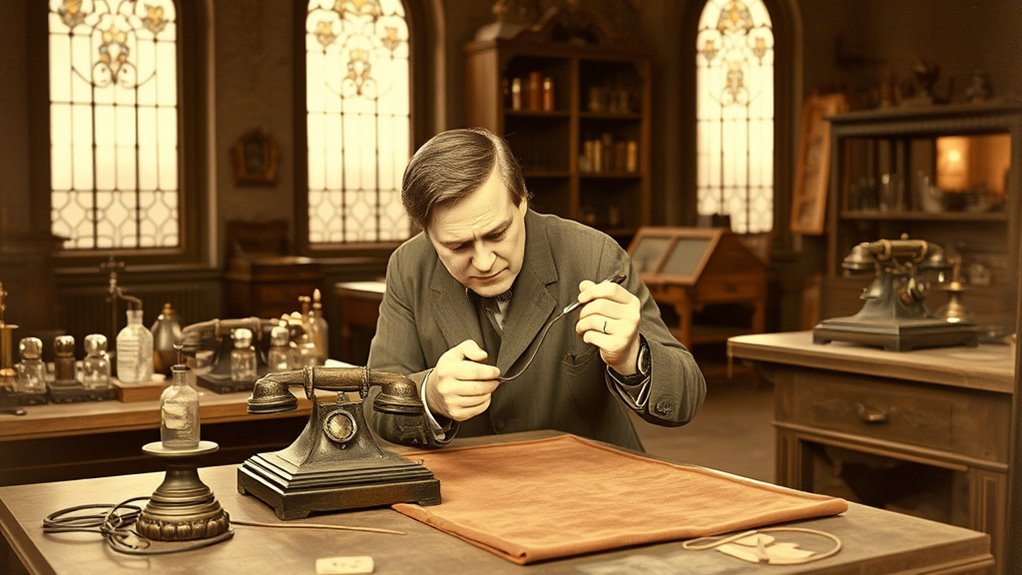
Have you ever wondered how we went from shouting across distances to talking instantly with someone miles away? It’s a fascinating journey that involves groundbreaking innovations in telephone technology and the genius of Alexander Bell. Before Bell’s invention, long-distance communication was limited to written letters or physical messengers, which could take days or even weeks. The idea of transmitting voice electronically was revolutionary, and Bell’s work changed everything. His pursuit of perfecting telephone technology aimed to make conversations across great distances quick and effortless, transforming how people connect globally.
From shouting across distances to instant voice chats—how Alexander Bell transformed communication forever.
Alexander Bell’s contribution to telephone technology was monumental. He was a Scottish-born scientist and inventor who dedicated himself to understanding sound and electrical transmission. In 1876, Bell successfully transmitted the first clear speech using his invention, famously stating, “Mr. Watson, come here.” This moment marked the birth of the modern telephone. Bell’s innovations weren’t just about capturing sound; they involved creating a device that could convert sound waves into electrical signals, transmit those signals over wires, and then convert them back into sound at the receiving end. This process became the foundation of telephone technology that would be refined over the years.
Bell’s invention was more than just a new device; it was a revolution in communication. His early prototypes laid the groundwork for the sophisticated networks we have today. The telephone allowed people to speak directly with loved ones, business partners, and colleagues without waiting for a letter or relying on third parties. As telephone technology evolved, so did the networks that linked cities and countries, shrinking the world and making communication faster and more efficient. The development of electrical transmission was a key factor in enabling these advances. Bell’s breakthrough also sparked fierce competition and further innovations, leading to the development of push-button phones, cordless calls, and eventually mobile devices.
Thanks to Bell’s pioneering work, the telephone became an indispensable part of daily life. It bridged gaps between families separated by distance, enabled businesses to operate more smoothly, and paved the way for future communication breakthroughs like the internet and mobile networks. His vision turned what once seemed like a distant dream into a practical reality that continues to evolve. Today, it’s hard to imagine a world without instant voice communication, all thanks to Alexander Bell’s relentless pursuit of better telephone technology. His invention didn’t just change how we talk; it transformed our entire way of connecting with each other, making the world feel a lot smaller and more accessible.
Top picks for "invention telephone bell"
As an affiliate, we earn on qualifying purchases.
Frequently Asked Questions
How Did Bell’s Invention Impact Global Communication Immediately?
Your world changed instantly with Bell’s invention, as wireless communication began to improve rapidly. You could now connect across long distances almost instantly, setting the stage for international networks. This breakthrough made global communication faster and more reliable, shrinking the world. People and businesses could share information instantly, transforming how nations interacted. Bell’s innovation laid the foundation for modern telecommunications, making worldwide connections accessible and shaping the future of global communication.
What Technical Challenges Did Bell Face During Development?
You face technical challenges like ensuring reliable electrical conduction and signal amplification. Bell had to develop a way to transmit clear voices over long distances, which meant improving the electrical conductivity of his device. He also needed to amplify weak signals without distortion, requiring innovative adjustments to the transmitter and receiver. These hurdles made the invention process complex, but overcoming them was key to creating a functional telephone.
Were There Any Patent Disputes Over the Telephone?
You might think patent conflicts and legal battles were rare during Bell’s time, but surprisingly, they were common. As the telephone’s potential grew, so did disputes over who truly invented it. Bell faced fierce legal battles and patent disputes, with rivals claiming they’d come up with similar ideas first. Ironically, these conflicts only highlighted how groundbreaking Bell’s invention was, fueling further disputes rather than settling them easily.
How Did the Telephone Influence Social Interactions in the 19TH Century?
You saw the telephone transform social interactions in the 19th century by reshaping social norms and boosting urban connectivity. It made communication faster and more personal, allowing you to connect instantly with others across cities and even countries. As a result, people became more accessible, relationships strengthened, and the pace of social life accelerated. The telephone’s influence created a more interconnected society, changing how you and others engaged socially every day.
What Were the Initial Public Reactions to the Telephone?
You likely saw public skepticism when the telephone was first introduced, with many questioning its usefulness and practicality. Despite this, early adoption grew slowly as people experimented with the device and realized its potential for instant communication. Over time, public opinion shifted, and the telephone became an essential tool, transforming how society connects. Your early experiences with the telephone reveal a mix of doubt and curiosity that fueled its eventual widespread acceptance.
Conclusion
You now know how Alexander Graham Bell revolutionized communication with the invention of the telephone. Did you know that by 1915, over half a million phones were in use across the United States? Imagine a world where talking to someone miles away took days or weeks—Bell’s invention made that a thing of the past. Today, it’s hard to picture life without this groundbreaking device, forever changing how we connect with each other.
College move-in / dorm season Picks
dorm essentials
As an affiliate, we earn on qualifying purchases.